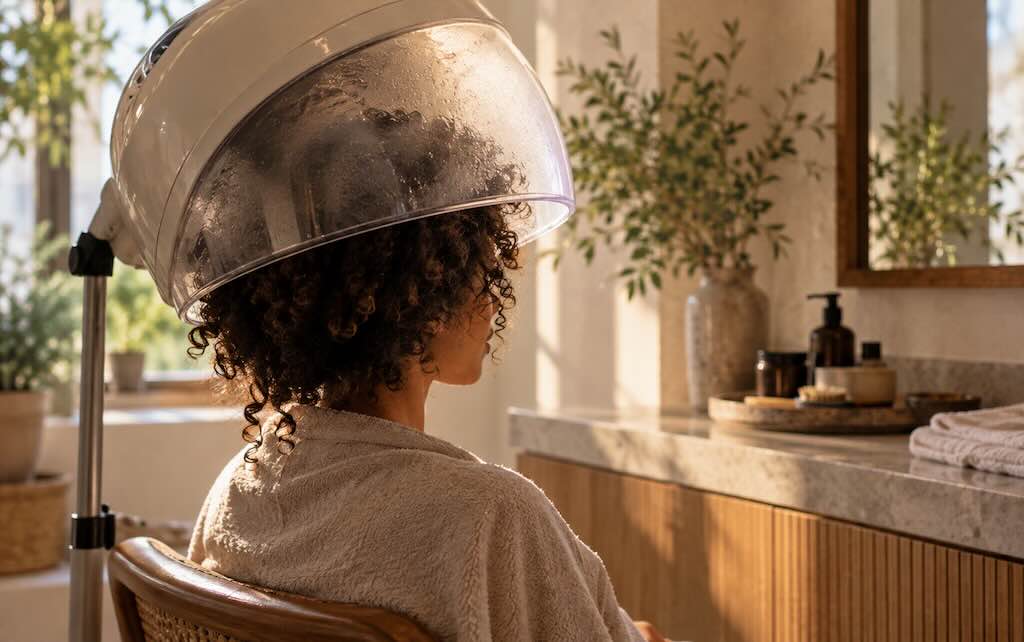
Hair steaming has the appealing logic of a treatment you can feel working.
Warm mist gathers around the hair. Conditioner becomes softer beneath your fingers. Curls can feel more pliable afterwards. Compared with simply putting on a shower cap and waiting, sitting beneath a cloud of steam seems much more active.
Online, the explanation usually goes further. Steam is said to “open the cuticle”, push moisture deep into the hair, rescue low-porosity strands and sometimes even encourage growth.
There is some sensible hair science underneath this. There are also claims that run considerably ahead of the evidence.
Start with what water actually does to hair
A strand of hair is not an impermeable thread. Its outer cuticle consists of overlapping cells protecting the cortex beneath, and the condition of that surface changes how the fibre interacts with water and hair products.
When hair comes into contact with water, it absorbs some of it and swells. Research into hair-fibre structure has documented this effect, and damaged or chemically treated hair can become particularly porous as the protective surface deteriorates.
This is where the familiar language about steam “opening” the hair cuticle becomes a little too neat. Hair does respond physically to water, humidity and heat, but the cuticle is not a set of doors that steam simply opens so conditioner can walk inside.
A better way to think about steaming is as a warm, humid environment during a conditioning treatment.
That sounds less dramatic. It is also closer to what we can reasonably say.
The conditioner is doing much of the useful work
This distinction matters because a good result after steaming is easily attributed entirely to the steam.
Conditioner already has a clear job. Conditioning ingredients deposit onto the hair surface, particularly damaged areas, helping reduce static and friction between fibres. They can improve softness, shine and ease of detangling while temporarily smoothing some of the irregularities of a weathered hair shaft.
In other words, if your hair feels softer and easier to comb after twenty minutes with conditioner under a steamer, at least part of what you are noticing is exactly what conditioner is formulated to do.
The useful question is whether steam makes that conditioning session work better for your particular hair.
Who may notice the biggest difference?
Hair steaming tends to make most practical sense for hair that benefits from careful conditioning and detangling.
That can include curly and tightly coiled hair, particularly when the aim is to make the hair more pliable before detangling. Longer hair with weathered ends may also feel easier to handle after a conditioning session. The same may be true of hair affected by colouring, bleaching or other chemical processing, although heavily damaged hair also needs gentler handling because damage makes the fibre more vulnerable to breakage.
None of this means steam reverses that damage. Once the hair shaft has been significantly weathered or chemically damaged, a cosmetic treatment can improve how it feels and behaves without returning it to an untouched state.
This difference between feeling better and being repaired is worth keeping.
What about low-porosity hair?
This is probably the claim most closely associated with hair steaming.
Porosity describes how readily hair interacts with and takes up water and other substances, and it is influenced by the condition of the fibre. Hair damaged through bleaching, chemical treatments, grooming and environmental exposure tends to become more porous as its protective surface deteriorates.
In online hair-care language, however, “low porosity” is often treated as a precise diagnosis with an equally precise solution: add steam so products can penetrate.
The evidence is not that tidy.
There is a scientific basis for saying that water affects the structure and swelling of hair fibres, and laboratory research can measure how ingredients penetrate or deposit within hair. But that does not establish a general rule that everyone whose hair resists wetting needs a steamer, or that steam will reliably drive any deep conditioner into the cortex.
If you describe your hair as low porosity and find that gentle steaming makes conditioning easier, that practical result may be enough reason to keep doing it. You do not need a grander biological claim to justify a routine that works for you.
It is not a hair-growth treatment
Hair steaming is sometimes discussed as though improving moisture around the scalp will encourage follicles to produce more hair.
That is a different claim from conditioning the hair shaft.
The visible strand and the follicle producing it are not the same thing. Making existing hair softer, reducing tangles or limiting unnecessary breakage can help you retain length and make hair appear healthier. That should not be confused with increasing the rate at which follicles grow hair or treating hair loss.
If increased shedding, thinning or patchy hair loss is the concern, a steamer is not a substitute for finding the cause. The American Academy of Dermatology recommends seeing a dermatologist for hair loss and, while hair is fragile, using gentle shampooing and conditioning practices that minimise additional breakage.
More heat is not more treatment
Steam can feel gentle because it is moist heat. Hair does not therefore become immune to temperature.
Research on hair fibres consistently shows that excessive heat can damage the cuticle, with surface damage increasing as temperatures rise. Wet hair also behaves differently from dry hair because the fibre has absorbed water and swollen.
A hair-steaming session should feel comfortably warm, not painfully hot. There is no useful reason to move extremely close to a source of boiling steam or improvise a treatment that risks burning the scalp, face or ears.
If you use a purpose-made steamer, follow its instructions rather than assuming a longer or hotter session must produce a better result.
You may not need a steamer at all
This is the less glamorous part of the answer.
If your hair already feels manageable after ordinary conditioning, adding steam may solve a problem you do not have.
Fine hair that becomes limp or heavily coated with rich conditioning treatments may not benefit from turning every wash day into a longer deep-conditioning session. Hair that is already fragile also needs protection from unnecessary manipulation and excessive heat more than it needs an elaborate routine.
There are simpler ways to give a conditioner time on the hair. Apply it thoroughly. Work in sections if that helps with coverage. Detangle gently according to the needs of your texture. Leave the product on for the time its manufacturer recommends.
Then see what your hair actually feels like.
A useful treatment does not need a miracle story
Hair steaming occupies an interesting place in beauty because the modest version of the claim is perfectly reasonable.
Warm humidity can make a conditioning ritual pleasant. Water changes the physical behaviour of hair. A well-formulated conditioner can improve softness, friction and manageability. For some textures and routines, putting those things together may make wash day noticeably easier.
What we do not have is good reason to turn that experience into a universal prescription for porosity, a way to permanently repair damaged strands or a treatment for hair growth.
If steaming leaves your hair easier to detangle, softer and nicer to handle, it may have earned its place in the routine.
If your conditioner works perfectly well without it, you are not missing a necessary step.