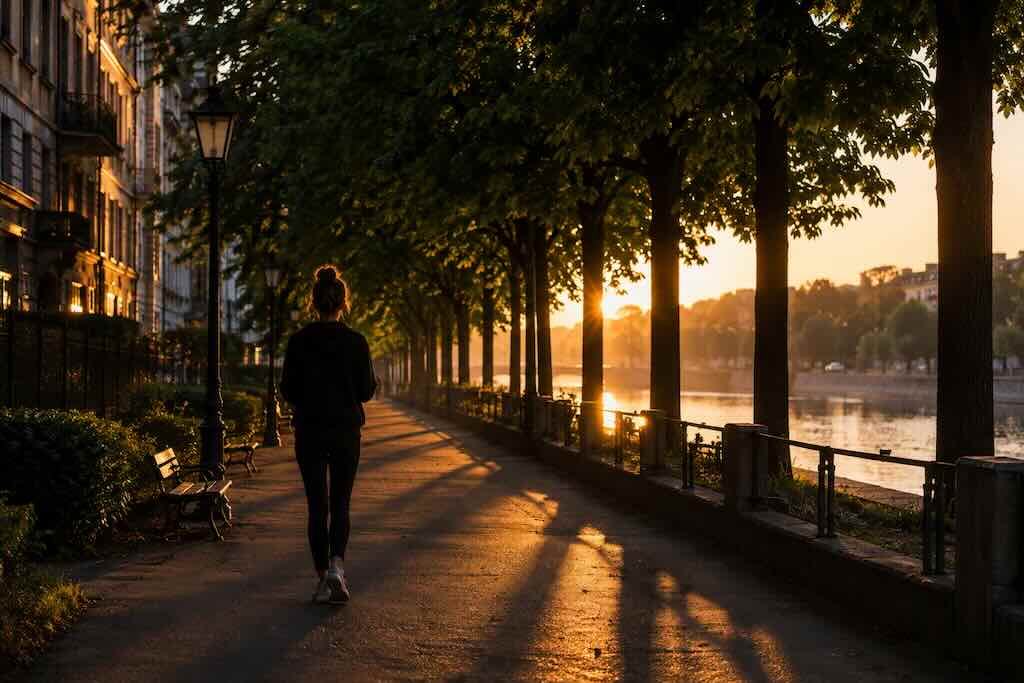
The same street is not really the same street at 7 a.m. and 7 p.m.
In the morning, shutters lift and delivery trucks occupy the curb. At noon, shadows shorten and traffic fills the gaps. Near sunset, windows begin reflecting the sky and people appear on their way somewhere rather than simply moving through the day.
Walk the same route at each hour and the distance does not change. Almost everything around it does.
A walk is partly made by its surroundings
Walking is often discussed as exercise, and with good reason. The CDC identifies both immediate and longer-term health benefits of physical activity, and brisk walking can contribute toward recommended weekly activity.
But most ordinary walks are experienced as more than a unit of exercise.
Temperature changes how quickly you move. Wind changes which streets feel comfortable. Traffic alters the soundscape. The position of the sun can make one side of a familiar block bright and the other unexpectedly cool.
The walk becomes a way of encountering the hour.
Morning has fewer layers
Early walks can make familiar places feel unusually exposed.
There are fewer conversations to overhear, fewer cars, fewer competing movements. Shops are still closed. A street usually understood through commerce becomes architecture, pavement, trees and light.
This does not make morning inherently calmer. In some neighborhoods it is the loudest part of the day. The point is that changing the hour changes what becomes noticeable.
The afternoon shows you how a place works
Walk at midday and the machinery of a neighborhood is often visible.
School entrances fill. Lunch counters turn tables. Construction is audible. Delivery doors open. Parks are used differently than they are before work or after dinner.
If morning can make a place feel spatial, afternoon makes it social. You begin to see who uses the street and what it is for.
Evening changes scale
As daylight recedes, attention moves closer.
Streetlights replace the sky as the dominant source of illumination. Windows become brighter than façades. Restaurants spill light onto sidewalks. Distances can feel shorter because the horizon becomes less visually important.
For some people, that makes an evening walk feel contained. For others, darkness, traffic or poorly illuminated streets make the same route less comfortable or less safe. Time of day changes a walk partly because it changes the conditions under which we move.
Try changing the hour before changing the route
There is no need to turn walking into another carefully designed routine.
If a familiar walk has become invisible through repetition, take it at a different time once. Notice where the light falls. Which businesses are open. Who is outside. What you can hear when traffic changes.
You may discover that novelty does not always require somewhere new.
Sometimes it requires arriving at the same place at another hour.
Frequently asked questions
Why does the same walk feel different at different times of day?
Light, temperature, traffic, noise, pedestrian activity and the way businesses and public spaces are being used all change over the course of a day.
Is morning the best time to go for a walk?
There is no single best time. Morning, afternoon and evening each create different conditions, and the most suitable time depends on weather, safety, schedule and personal preference.
Can walking the same route still feel interesting?
Yes. Changing the hour, direction or pace can make familiar details more noticeable without requiring a completely new route.