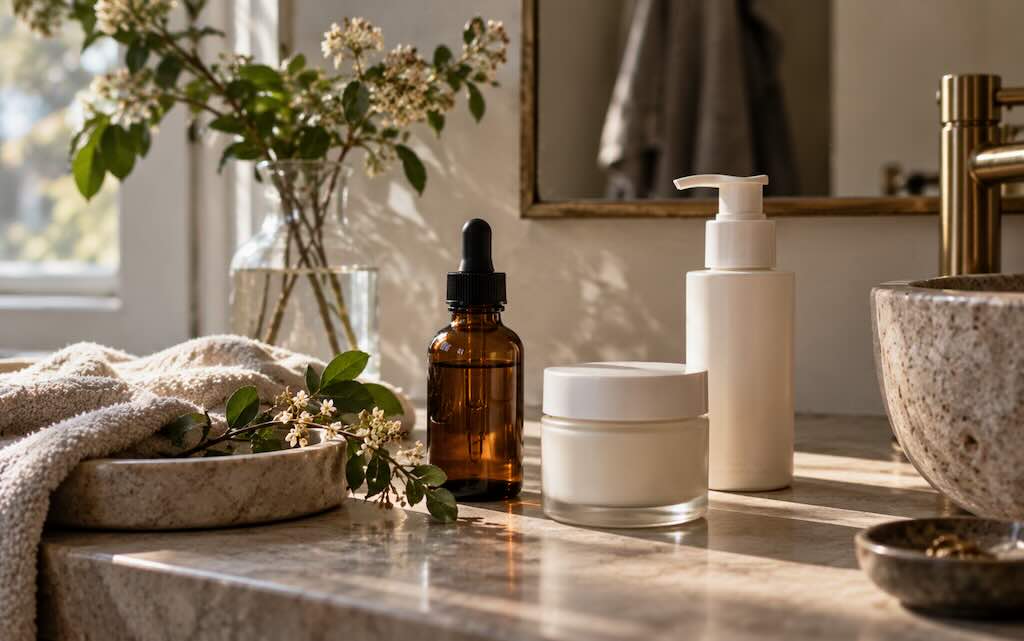
There is a particular kind of skincare packaging that seems to explain itself before you have read a word. Brown glass. Cream labels. A botanical drawing. Perhaps a pale green box that looks as though it belongs beside a linen towel and a branch of eucalyptus.
Then comes the word that ties the whole picture together: natural.
It sounds reassuringly simple. Plants rather than laboratories. Familiar ingredients rather than complicated ones. Something gentler, perhaps, or closer to its original state.
The label itself may be telling you considerably less.
There is no single definition waiting behind the word
In the United States, the Food and Drug Administration says it has not established a regulatory definition of “natural” for cosmetic labelling. A product does not therefore enter a clearly defined FDA category simply because the word appears on the bottle.
That does not mean companies can say absolutely anything. Cosmetic labelling in the US still has to be truthful and not misleading, and the Federal Trade Commission has previously taken action over personal-care products advertised as “all natural” or “100% natural” when they contained synthetic ingredients.
Europe approaches cosmetic claims through its own regulatory framework. EU guidance requires claims to meet common criteria including truthfulness, evidential support, honesty, fairness and allowing consumers to make informed decisions.
There are also voluntary technical standards. ISO 16128, for example, provides definitions and criteria relating to natural and organic cosmetic ingredients. But ISO itself makes an important distinction: its standard does not govern product claims and labelling, nor does it establish that a product is safe simply because an ingredient falls into one of its natural categories.
So when two moisturisers both say “natural,” the word alone does not tell you that they were formulated according to the same definition.
Natural describes origin better than performance
A plant can provide oils, waxes, fragrances, extracts and other ingredients useful in skincare. That still leaves several unanswered questions.
How much of the ingredient is present? How was it processed? What else is in the formula? Is the finished product stable? Does it suit your skin? What is the product actually supposed to do?
“Natural” cannot answer those questions on its own.
Nor does the source of an ingredient establish its safety. The FDA specifically advises consumers not to assume that natural or organic cosmetics are safer than products made with ingredients from other sources. Plants can contain substances capable of irritating skin or causing allergic reactions, just as synthetic ingredients need to be assessed for their intended use.
That distinction gets lost easily because “natural” is not merely descriptive language anymore. It has acquired a mood.
A leaf on the bottle is doing some of the talking
Imagine the same face cream in two packages.
One arrives in amber glass surrounded by leaves, muted colours and words about botanical origins. The other comes in a white tube with clinical-looking packaging and an ingredient name printed prominently on the front.
Before either has touched your skin, they have suggested two different stories. One belongs to nature. The other belongs to chemistry.
In reality, both belong to chemistry.
Water is a chemical substance. Plant oils are mixtures of chemical compounds. Ingredients extracted from plants can be filtered, distilled, fermented or otherwise processed before reaching a bottle. Laboratory-made ingredients can be designed to perform very specific functions within a formula.
None of this makes one category inherently better. It makes the opposition between “natural” and “chemical” much less useful than skincare packaging sometimes allows it to appear.
Natural and organic are not interchangeable
The two words often occupy the same visual world, but they do not mean the same thing.
“Natural” generally concerns where an ingredient comes from or how it is characterised under a particular standard. “Organic” can involve defined agricultural production and certification requirements.
In the US, for example, the FDA does not define “organic” for cosmetics under the laws it administers, but the US Department of Agriculture’s National Organic Program can apply to cosmetic products containing agricultural ingredients when they meet its certification and labelling requirements. The FDA explains the distinction in its guidance on organic cosmetics.
A botanical-looking package is not itself evidence of organic certification. Neither is the presence of a recognisable plant ingredient.
The ingredient list is less romantic and more useful
The front of a skincare bottle is where the product introduces itself. The ingredient list is where some of the more practical information begins.
In the US, cosmetic ingredients sold at retail generally have to be declared using their common or usual names and are generally listed in descending order of predominance, subject to specific labelling rules. That does not make an ingredient list a simple ranking of quality, and reading one still requires context.
But it can answer questions that the word “natural” cannot.
Does a product contain fragrance when you prefer to avoid it? Is the ingredient advertised prominently on the front actually part of the formula? Does the product contain something you already know your skin reacts to?
You do not need to become fluent in cosmetic chemistry every time you buy cleanser. You only need to recognise that the reassuring word on the front and the useful information on the back are doing different jobs.
A familiar ingredient can still irritate unfamiliar skin
Essential oils make the problem particularly easy to see.
Lavender, citrus and other aromatic plant ingredients can feel intuitively gentle because their names are familiar. But familiarity is not a measure of how skin will respond.
The FDA notes that some plant-derived essential oils can be irritating or cause allergic reactions, and that certain citrus oils can create problems when used on skin exposed to sunlight.
This is not a reason to fear botanical ingredients. Plenty of people use products containing them without difficulty. It is a reason to stop using botanical origin as shorthand for gentleness.
Your skin does not know that the ingredient came with a picture of a flower.
Ask a more specific question than “Is it natural?”
If natural ingredients matter to you, the word can still be useful as the beginning of a conversation with a product rather than the end of one.
Look for specificity. Does the company explain what it means by natural? Does it identify a standard or certification? Does it tell you what proportion of the formula meets that definition? Are the claims about ingredients separate from claims about what the product can actually do?
Then bring the decision back to your own skin.
A straightforward moisturiser that does what you need and causes no problems may be a better purchase than a beautifully packaged botanical formula that irritates you. Someone else may prefer plant-derived ingredients for reasons that have little to do with performance. Those preferences can coexist without turning “natural” into a synonym for good.
The useful question on a skincare shelf is rarely whether nature or the laboratory wins.
It is what is actually in this bottle, what evidence sits behind its claims, and whether your skin likes what happens when you use it.
FAQ
What does “natural” mean in skincare?
There is no single definition that applies to every skincare product and market. In the US, the FDA has not established a regulatory definition of “natural” for cosmetic labelling. Companies or voluntary standards may use their own defined criteria, so the specific claim needs context.
Is natural skincare safer?
Not necessarily. Ingredient origin alone does not determine safety. Plant-derived ingredients can irritate skin or cause allergic reactions, while synthetic ingredients also need to be safe for their intended cosmetic use.
Does natural skincare mean chemical-free?
No. Everything in a skincare formula is made of chemical substances, including water and ingredients obtained from plants. “Chemical-free” is therefore not a useful scientific distinction between natural and synthetic skincare.
Is natural skincare the same as organic skincare?
No. Organic claims can relate to specific agricultural production and certification standards, while “natural” may be defined differently depending on the company, standard or market. A natural claim does not automatically mean a product is certified organic.
What should I look for instead of the word “natural”?
Consider the complete ingredient list, the purpose of the product, any ingredients you know you react to, instructions and warnings, and how specific and well-supported the product’s claims are. If a natural claim matters to you, look for an explanation of how the company defines it or which recognised standard it follows.