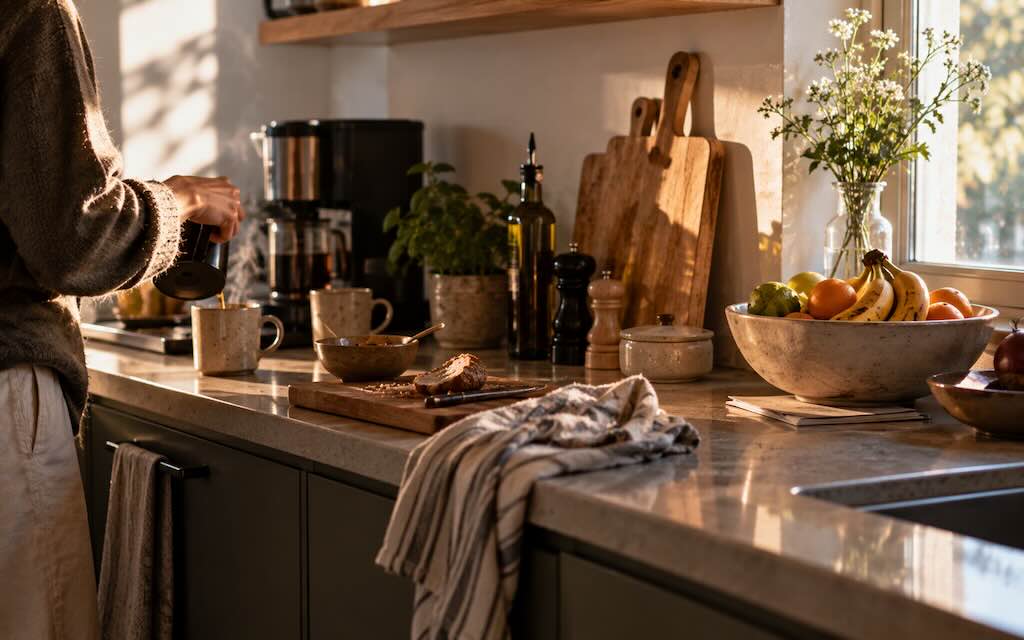
There are kitchens photographed for interiors magazines in which almost nothing appears to happen on the counter. A bowl of lemons. Perhaps a beautiful wooden board leaning against the wall. Everything else has apparently found a cupboard.
Then there is the kitchen at eight on a weekday morning.
The coffee machine is still warm. A mug has been abandoned beside the sink. There is a bottle of olive oil near the hob because putting it away every evening would be ridiculous when it will be needed again tomorrow. A bunch of bananas is becoming progressively less convincing. Someone has left a letter beneath the fruit bowl. The toaster is permanently out because nobody can quite imagine storing a toaster between uses.
A kitchen counter is ostensibly a work surface. In practice, it becomes something closer to a map of domestic priorities.
What remains visible tends to be what is used often, what has nowhere better to go, what we intend to deal with later and what we like having within reach. These are small decisions, repeated so often that they barely register as decisions at all.
Look closely at a counter and you can often see how a household actually moves through its day.
The things that earn permanent space
Counter space is unusually competitive territory.
Most kitchens have less of it than their owners would like, which makes permanent residence revealing. An appliance left out every day has effectively been judged useful enough to consume part of one of the room’s most valuable surfaces.
For one person, that is an espresso machine. For another, a kettle. There are kitchens organised around a toaster, rice cooker, blender, air fryer or stand mixer. Some have almost no machinery visible beyond a coffee grinder. Others resemble small electrical workshops by breakfast.
None of these arrangements necessarily says much about someone’s taste. They say considerably more about repetition.
The object that stays out is often the object around which a habit has formed.
A coffee setup can occupy an improbable amount of space because making coffee is not experienced as an occasional kitchen task. It belongs to the architecture of the morning. The kettle sits beside the tea rather than inside a cupboard because the few seconds saved by leaving everything together are repeated hundreds of times a year.
Convenience, when repeated daily, becomes a kind of domestic design.
Then there are the things that are only supposed to be there temporarily
These may tell us more.
A kitchen counter has an extraordinary ability to attract objects that have nothing to do with cooking. Keys arrive. Receipts arrive. Sunglasses, chargers, pens, unopened post and reusable shopping bags arrive. A parcel is placed there because it needs to be returned. Three days later it has become part of the kitchen.
The reason is usually practical. Kitchens are high-traffic rooms, and counters offer an easy horizontal surface at precisely the moment someone enters carrying something.
But temporary objects also expose a category of domestic life that storage advice tends to underestimate: things in progress.
The letter needs an answer. The batteries need recycling. The supermarket receipt is being kept until someone is certain the new coffee machine works. The reusable bottle belongs to the person leaving again in twenty minutes. Putting these objects completely away would make the kitchen look calmer, but it could also make the unfinished task easier to forget.
Visible clutter is sometimes simply memory outsourced to a surface.
That is why attempts to clear a counter can produce the strange experience of picking something up, walking around with it and eventually putting it back exactly where it was. The problem was never that you had forgotten to tidy it. The object did not yet have a meaningful destination.
A clear counter can mean several different things
Minimal kitchens are easy to interpret as evidence of an unusually organised life, but the surface alone cannot tell us that.
Some people genuinely feel better when the counter is empty and reset it every evening. For them, putting the coffee grinder back in a cupboard is not an irritating extra step. Clearing the surface is part of finishing the day.
Other kitchens look minimal because they have excellent storage. Or because their owners cook infrequently. Or because the photograph was taken five minutes after everything had been put away.
The reverse is true too. A crowded counter does not necessarily indicate disorder. It may belong to someone who cooks constantly and wants salt, knives, oil and utensils exactly where they can be reached. A kitchen used intensively develops its own logic, and that logic is not always visually sparse.
The useful distinction is less between tidy and untidy than between surfaces that support the way a household lives and surfaces that have become difficult to use.
There is a point at which convenience becomes obstruction. When preparing dinner requires moving six unrelated objects before finding enough room for a chopping board, the counter is no longer remembering the day for you. It is getting in the way of it.
Some objects are there because we like seeing them
Utility does not explain everything.
A ceramic jug could live behind a cupboard door but stays beside the stove. The good wooden board is left leaning against the backsplash. A bowl bought on holiday becomes the place for onions. There are cookbooks on counters belonging to people who rarely need to consult them and small plants occupying space that could plainly be used for food preparation.
These objects sit somewhere between equipment and decoration. They make a working room feel personal without requiring it to stop working.
Often they acquire their place slowly. The jug is left out after being used and looks right there. The bowl proves useful. A cutting board develops a darkened surface and worn edge that makes a new one seem strangely anonymous. Nobody formally decides that these things should define the kitchen. They simply survive each round of putting things away.
This is one of the ways a home begins to feel lived in. Its appearance is shaped not only by what was bought for it, but by what repeatedly escapes storage.
The counter changes over the course of a life
There are periods when a kitchen counter tells the story particularly clearly.
Move into a new home and the first few weeks can be visible there: tools, instruction manuals, a tape measure, the one mug that was unpacked before everything else. A new interest in baking brings flour jars and scales into permanent view. Working from home can quietly introduce notebooks and charging cables. A household with small children accumulates an entirely different layer of bottles, cups, snacks and objects placed temporarily out of reach.
Then routines change and objects retreat.
The blender used every morning for two years goes into a cupboard and somehow never comes back out. A bottle steriliser disappears. The enormous coffee machine is replaced by a small pot. A fruit bowl that was always full sits empty because nobody in the house eats breakfast at home anymore.
These are minor alterations, but domestic life is largely made from minor alterations. The rooms around us record them before we think to.
What stays out is often what matters today
There is a temptation to treat every visible object as a storage problem. Sometimes it is. Kitchens need enough clear surface to function, and few people feel restored by a counter they can no longer use.
Still, the completely cleared kitchen can be a peculiar standard for a room whose purpose is daily work.
The olive oil beside the stove is evidence that somebody cooks. The mug by the coffee machine belongs to a morning that happened quickly. The bowl of fruit is optimistic in the particular way fruit bowls often are. The post beneath it will probably be moved tonight. Or tomorrow.
None of this needs decoding into personality types. A toaster does not reveal your character, and a pile of keys is not a diagnosis.
But together, the objects left within reach describe something simpler: what gets repeated here, what is unfinished, what is useful enough to deserve space and what someone likes having around.
Tomorrow, the arrangement will be slightly different.
That may be the most accurate thing about it.
FAQ
What should you keep on a kitchen counter?
There is no universal list. Objects used frequently enough to benefit from being immediately accessible are sensible candidates, provided they do not leave too little working space. Daily coffee or tea equipment, cooking oils, a utensil container or regularly used appliances may make more sense on the counter than stored away.
Why does clutter always collect on the kitchen counter?
The kitchen is often a high-traffic part of the home, and a counter provides an easy place to put down objects carried in from elsewhere. Items connected with unfinished tasks can also remain visible because seeing them acts as a reminder.
Does a kitchen need clear counters to feel calm?
Not necessarily. Some people prefer almost empty surfaces, while others find a kitchen more comfortable when frequently used or personally meaningful objects remain visible. The more practical question is whether there is enough clear space for the kitchen to function easily.
How can you reduce kitchen counter clutter without hiding everything?
Start with objects that have no relationship to kitchen routines and give frequently abandoned items a convenient destination nearby. Grouping things used together can also preserve accessibility while making the counter easier to work on.
Why do lived-in kitchens often feel more inviting?
Visible signs of ordinary use can make a room feel inhabited rather than staged. Worn boards, frequently used ceramics, fruit, cooking equipment and other everyday objects show how the space participates in daily routines.