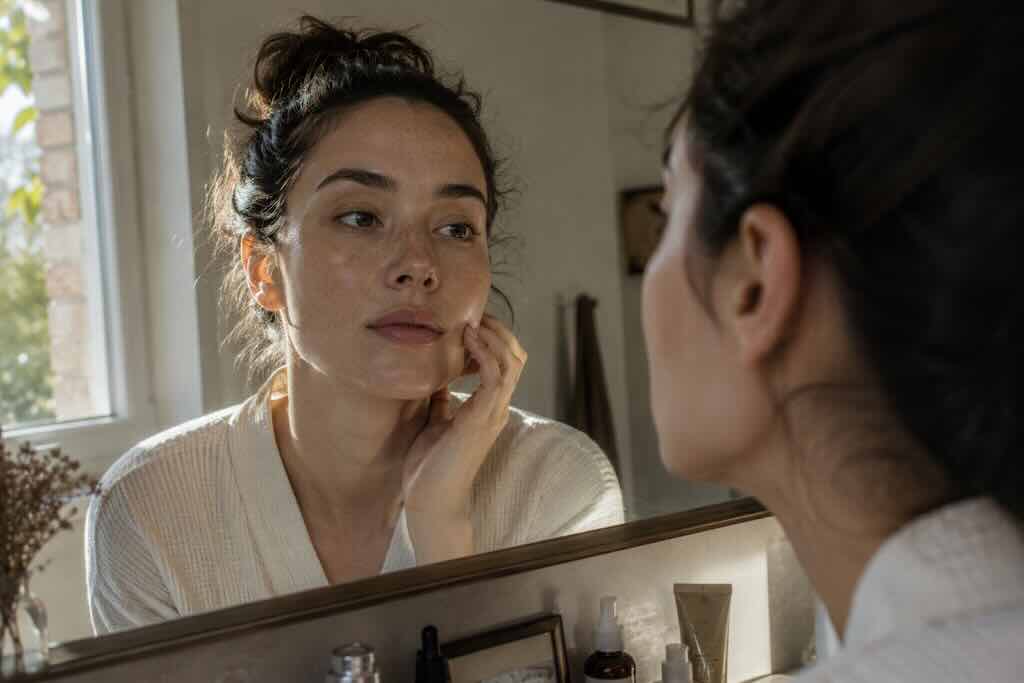
You can look in the mirror at 8 a.m., again at three in the afternoon and once more before bed and feel as though you have seen three slightly different versions of your face.
In the morning, your eyes may look a little fuller and your skin softer. By afternoon, texture that seemed invisible earlier can become more noticeable. At night, under a bathroom light, shadows appear in places you did not see near the window that morning.
Your face has not fundamentally changed over the course of those hours. But several smaller things have: the light around you, your skin’s surface, fluid distribution, facial movement and, importantly, the way you are looking at yourself.
Table of Contents
- Light may be changing more than your face is
- Your face really does change slightly after you wake up
- Skin develops a different surface as the day goes on
- Your expressions leave temporary traces
- Mirrors introduce another variable
- Phone cameras can make the difference feel even larger
- There is no one correct version of your face
- Frequently asked questions
Light may be changing more than your face is
The most immediate explanation is often the simplest one: you are rarely seeing your face under identical lighting conditions.
Morning daylight coming through a window can be relatively soft and diffuse. Depending on the weather, season and direction of the window, it may spread across the face without producing especially hard shadows.
Move into stronger overhead lighting and the geometry changes. Light from above can create shadows beneath the eyes, nose and chin. Light coming primarily from one side emphasizes contours differently. Bright, directional light can make pores, fine lines, small hairs and surface texture much easier to see.
Color matters too. Daylight changes throughout the day, while indoor bulbs vary considerably in color temperature. The U.S. Department of Energy’s guide to lighting explains how light sources differ in characteristics including color temperature, one reason skin and other colors can appear different under warm indoor lighting than they do in daylight.
This is also why judging makeup in a single mirror can be misleading. What looks seamless under one light source may look noticeably different when you step outside.
Your face really does change slightly after you wake up
Not every difference is an illusion of lighting.
After spending hours lying down, fluid can temporarily collect differently in the tissues around the eyes. The Cleveland Clinic notes that fluid retention can contribute to puffiness and bags beneath the eyes, particularly after waking. Individual factors, including sleep and fluid retention, can affect how noticeable this is.
Once you are upright and moving around, mild morning puffiness may become less pronounced.
The change can subtly affect the proportions and shadows you see in the mirror. Eyes may look different, cheek contours may appear slightly altered and features that looked particularly soft immediately after waking can become more defined later.
Skin develops a different surface as the day goes on
The skin you see immediately after washing your face is not quite the same surface you see eight hours later.
During the day, natural oils, perspiration, skincare, sunscreen and makeup can all alter the way light reflects from the skin. Sebaceous glands produce sebum, an oily substance that helps protect the skin; the Cleveland Clinic explains the role of sebaceous glands and sebum in maintaining the skin’s surface.
That affects appearance in surprisingly visible ways.
A smoother or more hydrated surface can reflect light differently from one that is dry. Oil can create highlights across the forehead, nose or cheeks. Makeup can settle, fade or mix with the skin’s natural oils, changing its finish and sometimes its apparent color.
None of these changes necessarily means your skin has become “worse” during the day. Its surface is simply no longer in the same condition it was in when you first finished getting ready.
Your expressions leave temporary traces
A face at the end of a day has also spent that day being used.
You have talked, smiled, squinted at screens or sunlight, eaten, concentrated and reacted to other people. Normal facial movement changes the appearance of the face from moment to moment, while expression lines can become more apparent with particular movements, skin conditions and lighting.
Even the way you hold your face changes. The expression of someone half-awake in morning light is not the same as the expression they make while concentrating at a desk or examining themselves closely in a mirror at night.
We tend to think of our face as a fixed image. In reality, other people almost never encounter it that way. They see it moving.
Mirrors introduce another variable
There is no single neutral mirror environment.
A bathroom mirror viewed from close range under overhead lights gives you one version. A hallway mirror several feet away gives you another. A small mirror beside a bright window gives you another still.
Distance is particularly easy to overlook. Move very close to a mirror and tiny variations in skin texture become prominent simply because you are examining your face at a distance from which other people rarely see it.
The same is true of magnifying mirrors. They are useful for particular tasks, but they are not an especially representative way to assess how your face ordinarily looks.
Phone cameras can make the difference feel even larger
Then there is the front-facing camera.
A photograph is affected by lens choice, camera distance, angle, exposure and image processing. Holding a phone close to your face can exaggerate perspective, making features nearer the camera appear proportionally larger than those farther away.
This is measurable rather than merely a dislike of selfies. A study published in JAMA Facial Plastic Surgery modeled the distortion created by short camera distances and found that taking a photograph from close range can noticeably alter the apparent proportions of facial features, particularly the nose.
Phones may also process images automatically, adjusting exposure, contrast, sharpness and other characteristics. Add a completely different light source and it becomes unsurprising that a face on a phone screen does not perfectly resemble the one you saw in the mirror moments earlier.
Neither image is necessarily revealing a more “real” face. They are different representations produced under different conditions.
There is no one correct version of your face
Beauty culture often encourages close inspection. Mirrors become brighter, cameras become sharper and images can be enlarged until details that barely register in ordinary conversation occupy an entire screen.
It is easy, under those conditions, to interpret every visible difference as something happening to your appearance.
Sometimes something has changed. Often, however, you have changed the conditions under which you are looking.
If you want to understand how significant lighting is, try looking at your face in several places without changing anything else: beside a window, farther inside the room and beneath an overhead light. The differences can be immediate.
It is a useful reminder that a face is not a studio photograph. It exists in changing light, in motion and across an entire day. There was never going to be only one version of it.
Frequently asked questions
Why does my face look different in the morning?
Your face can look slightly puffier after waking because fluid retention can affect the tissues around the eyes. Morning lighting, sleep and the condition of your skin can make the difference more or less noticeable.
Why does my skin look better in morning light?
Soft, indirect daylight can produce fewer pronounced shadows than harsh overhead or directional lighting. Your skin may also have a different surface immediately after cleansing and applying skincare than it does later in the day.
Why does my face look more tired at night?
Several factors can contribute. Indoor evening lighting may emphasize shadows around the eyes and other facial contours, while makeup, skin oils, dryness and a full day of facial movement can change the appearance of the skin. Actual tiredness may affect your expression as well.
Why do I look different in a mirror and a phone camera?
Mirrors and cameras create different representations of your face. Camera distance, lens perspective, angle, lighting and image processing can all affect a photograph, while a mirror shows a reflected image that you usually view from a different distance.
What lighting gives the most useful view of your face?
For everyday tasks such as checking makeup, soft natural daylight from a window can provide a useful reference because it avoids some of the strong shadows and color shifts produced by certain indoor lights. It is still worth checking your appearance in more than one type of light if you will be moving between environments.