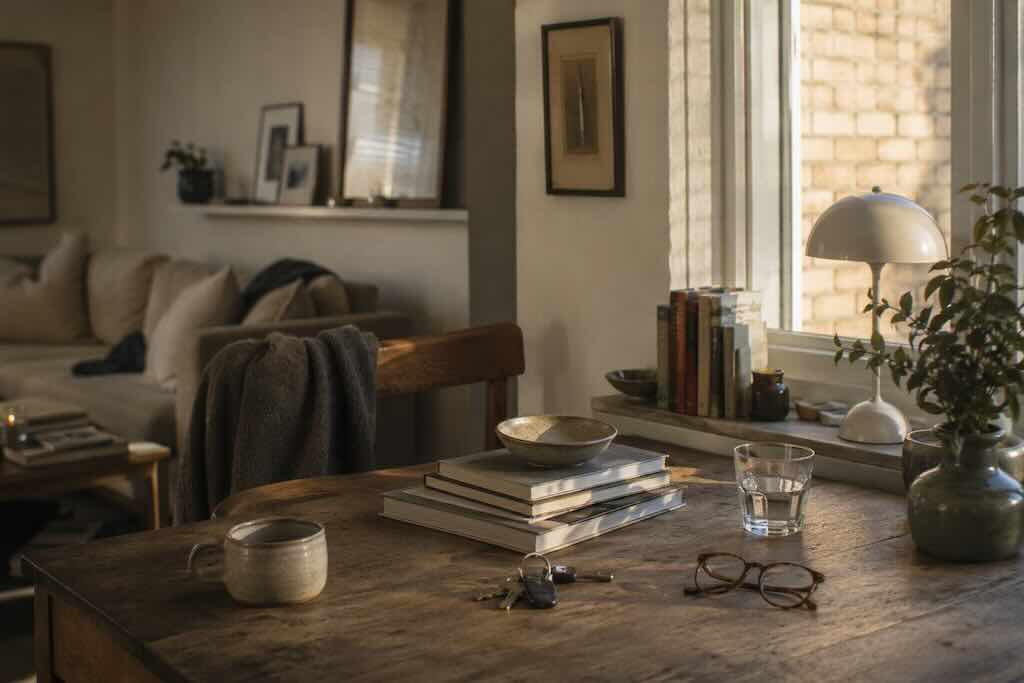
You probably know where almost everything in your home is, but that does not mean you still see it.
The bowl by the door. The lamp in the corner. A photograph that has been sitting on the same shelf for six years. The chair nobody deliberately chose as a place to leave clothes but which somehow acquired the job anyway.
These things remain part of the room, yet after enough time they begin to recede. A visitor may notice them immediately. You can walk past them several times a day without giving them a thought.
It is one of the peculiar things about living somewhere: familiarity gradually makes parts of our surroundings almost invisible.
Table of Contents
- A home becomes familiar by disappearing a little
- Someone else sees a different room
- The things that disappear are not necessarily unimportant
- Moving something can make it visible again
- Photographs expose what familiarity hides
- Homes accumulate without asking permission
- Looking again does not require changing everything
- Frequently asked questions
A home becomes familiar by disappearing a little
When you first move into a room, there is a period when everything seems unusually visible. You notice the way afternoon light falls across a particular wall. You are aware of the distance between the sofa and the window. A floorboard creaks. A cupboard door closes differently from the others.
Even your possessions can look different simply because they are standing somewhere new.
Then the room becomes home.
That familiarity is useful. We could hardly function if every lamp, table edge and framed picture demanded our full attention each time we entered a room. Researchers describe one relevant process as habituation: repeated exposure to a stimulus can gradually reduce our response to it. Research into visual attention has similarly found that repeated, familiar stimuli can become less effective at capturing attention, leaving more attention available for what is new or currently important.
The result is that the home we know most intimately can also be the place we observe least closely.
Someone else sees a different room
Visitors occasionally reveal this gap.
Someone asks about a print on the wall and, for a moment, you have to turn around to remember which one they mean. They admire a lamp you have not consciously looked at in months. They notice the view from a window that has become part of the background of making coffee, checking the weather and looking for your keys.
Nothing has changed. What has changed is the attention being brought into the room.
A guest encounters the space without its accumulated familiarity. They do not know which objects are expensive, accidental, sentimental or due to be replaced. They simply see what is there.
Sometimes their attention briefly gives an object back to us.
The things that disappear are not necessarily unimportant
Oddly, some of the least noticed objects in a home can be among the most used.
A favorite mug rarely announces itself as a favorite mug. It is simply the one repeatedly taken from the cupboard. The hook by the door becomes part of the choreography of leaving the house. The reading lamp gets switched on at roughly the same point each evening without becoming an event.
Objects like these acquire their significance through repetition rather than novelty.
That makes them different from objects chosen primarily to be noticed. A striking vase may dominate a room when it first arrives, while the slightly battered table beside it quietly participates in thousands of ordinary moments.
The objects that matter to daily life are not always the ones that photograph best.
Moving something can make it visible again
One of the simplest ways to notice this phenomenon is to move something.
Put a familiar chair on the opposite side of the room and it can suddenly look almost new. Move a picture from one wall to another and you may start looking at it again. Clear everything from a shelf before putting the same objects back and each object briefly regains its outline.
The object has not changed. Its context has.
This may partly explain why rearranging a room can feel disproportionately satisfying. Changing the familiar arrangement introduces something unexpected into a space your attention has learned extremely well. For a while, the room asks to be looked at again.
Photographs expose what familiarity hides
A photograph can do something similar.
Take an ordinary picture of a room and look at the photograph rather than the room itself. Suddenly the crooked cushion becomes obvious. So does the cable running along the floor, the plant that has grown much larger than you realized and the pile of mail that had apparently become architecture.
But photographs can reveal pleasant things too: the shape of the morning light, the combination of colors that happened without planning, the way an old wooden table has worn along its edges.
The frame removes some familiarity. For a moment, your own room becomes an image of a room, and that small distance can make it easier to see.
Homes accumulate without asking permission
There is another reason objects become invisible: homes change slowly.
Most rooms are not created in a single afternoon. Things arrive one at a time. A book is placed on a table. A postcard gets propped against a mirror. A charger establishes permanent residence beside the sofa. A plant grows. A stack forms.
Because each change is small, we rarely experience the room as dramatically different. But compare it with a photograph from three years earlier and the accumulation becomes obvious.
This is part of what makes a genuinely lived-in home different from a newly styled one. Its appearance contains decisions, certainly, but also habits, accidents, compromises and time.
Not everything is there because somebody decided it would look good there.
Looking again does not require changing everything
Much of contemporary interiors culture is built around transformation. Rooms are refreshed, upgraded, reorganized and made over. Sometimes a room genuinely needs changing. Sometimes the impulse to change it arrives before we have really looked at what is already there.
There is a quieter alternative: walk through your home as though you have not seen it before.
Notice which objects your eyes pass over. Look at what has collected beside the bed. Pay attention to what catches the light. Consider which things you touch every day and which have remained untouched for years.
This does not have to become an exercise in decluttering. The answer to noticing an object is not necessarily to get rid of it.
You may instead remember where it came from. You may realize how useful it has become. You may move it somewhere else. Or you may simply see it properly for the first time in a long while.
A home is partly made from the things we choose. It is also made from the things that stay long enough for us to stop noticing them. Every so often, it is worth looking again.
Frequently asked questions
Why do we stop noticing familiar objects?
Repeated exposure can make familiar stimuli less likely to demand the same level of attention they received when they were new. This process is related to habituation and helps attention remain responsive to changes and potentially more relevant information in the environment.
Why does rearranging a room make it feel different?
Changing the position of familiar furniture or objects interrupts patterns you have become accustomed to. Even when nothing new has been added, a different arrangement introduces novelty and can make you pay closer attention to the room again.
Why does my home look different in photographs?
A photograph changes the way a room is perceived by turning a three-dimensional, familiar environment into a fixed frame. That distance can make proportions, clutter, light, color and small details more noticeable than they are during everyday life.
How can I see my home with fresh eyes?
Small changes can help: photograph a room, move a familiar object, clear and restyle a shelf, enter through a different doorway or simply spend a few minutes looking at the space without trying to improve it. The point is not necessarily to redecorate, but to interrupt familiarity long enough to notice what is already there.