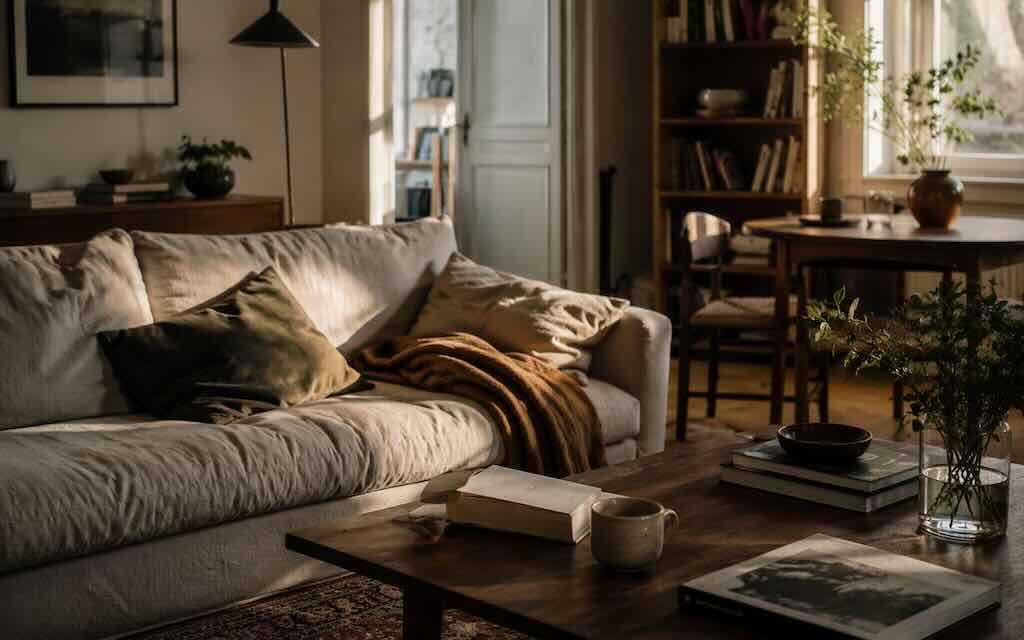
A glass left beside the sink. A book face-down on the arm of a sofa. Shoes gathered near the door because that is where people actually take them off.
None of these details would necessarily survive the few minutes before an interior photograph is taken. Yet they are often the details that make a room feel convincing.
There is a difference between a home that has been arranged beautifully and one that seems to belong unmistakably to the people living there. The latter can still be thoughtful, orderly and visually quiet. It simply carries evidence of a life beyond the composition.
That quality is difficult to buy because it develops through use.
Table of Contents
- A room tells you what happens there
- Personal things matter more than decorative things
- Not everything needs to look intentional
- There is a difference between evidence of life and overwhelming clutter
- Useful objects deserve to be seen
- Rooms get better when they are allowed to change
- Leave some decisions unfinished
A room tells you what happens there
Consider two otherwise similar living rooms. Both have a sofa, a lamp, a coffee table and shelves. In one, every object appears to have been chosen to complete the room. In the other, the objects begin to explain its occupants.
There might be a reading lamp pulled closer to one particular chair. Records sit beside the turntable rather than arranged by color on a distant shelf. A blanket stays within reach because someone gets cold in the evening. The coffee table carries something that was being read yesterday.
These are small clues, but together they answer an important question: what do people do here?
Research into the meaning of home has long suggested that a residence is more than its physical structure. A study published in the Journal of Environmental Psychology identified qualities including continuity, privacy, self-expression, personal identity, social relationships and warmth among the characteristics people associated with home.
That helps explain why an immaculate room can sometimes feel strangely anonymous. It may communicate a design language very clearly while saying almost nothing about its inhabitants.
Personal things matter more than decorative things
A home does not become personal simply by containing more objects. What matters is the relationship between those objects and the people around them.
A framed photograph from an ordinary afternoon can carry more identity than an expensive decorative object selected because a shelf looked empty. A chipped bowl brought home from a trip may remain because someone remembers where it came from. A child’s drawing might share a wall with carefully chosen art.
Recent research into personalization and psychological wellbeing in the home has also found a relationship between personalization and how people perceive and associate with their homes.
The point is not that every possession needs a story. Few people feel sentimental about a phone charger. But rooms become distinctive when at least some of their contents have arrived through living rather than decorating.
Not everything needs to look intentional
Contemporary interiors are often presented through images designed to be understood almost instantly. A room has a palette. Objects repeat colors. Books form neat stacks. Cushions sit at deliberate angles. Nothing interrupts the frame.
Real rooms have another layer: interruption.
The chair moves toward the window on a sunny morning. Flowers begin to drop petals. Someone brings another mug into the room. A jacket spends an evening over the back of a chair.
Allowing some of this temporary disorder does not mean abandoning care. It means recognizing that a home changes over the course of a day.
The most convincing rooms often contain both states at once: underlying order and evidence of movement.
There is a difference between evidence of life and overwhelming clutter
Romanticizing every pile of possessions would miss something important.
The UCLA Center on Everyday Lives of Families documented the material environments of 32 dual-income, middle-class Los Angeles families in an unusually detailed study of domestic life. Researchers photographed homes, recorded family interactions and examined how possessions accumulated across everyday spaces. Their work found that managing large volumes of belongings could itself become a source of strain.
Separate research published in the Journal of Environmental Psychology found a similar tension: possessions can contribute to a sense of psychological home, while an overabundance experienced as clutter can undermine it.
That distinction is useful.
A lived-in home does not need to be crowded. An almost empty apartment can feel deeply personal; a room containing hundreds of objects can feel impersonal. The question is not how much is visible, but whether what is there supports the life happening around it.
Useful objects deserve to be seen
One reason styled interiors can feel artificial is that practical objects have often disappeared from view.
But daily life has equipment.
There are reading glasses, speakers, chargers, dog leads, remote controls, fruit bowls, notebooks, umbrellas and half-finished puzzles. Kitchens contain appliances people actually use. Bathrooms require towels. Entryways accumulate the things needed to leave the house.
Good storage matters precisely because not everything needs to remain visible. Yet hiding every functional object can remove the visual rhythm of daily life along with the mess.
Sometimes the most natural solution is simply to let an attractive, frequently used object remain where it is needed.
Rooms get better when they are allowed to change
Some homes appear finished immediately because almost everything was purchased within the same period. The colors correspond. The furniture belongs to the same visual moment. Nothing feels accidental.
Time tends to make rooms less coherent and more interesting.
A new chair meets an old table. A photograph appears after a trip. A lamp moves because the original position never quite worked. Something inherited sits beside something inexpensive. The plant that began on a windowsill eventually becomes too large for it.
This gradual editing creates combinations that would be difficult to reproduce by buying an entire room at once.
It also allows the home to respond to its occupants. People change jobs, develop hobbies, have children, start working from home, begin cooking more often or discover that the supposedly perfect chair is uncomfortable. A room that accommodates those changes is doing more than maintaining an aesthetic.
It is working.
Leave some decisions unfinished
An empty wall does not always require art. A vacant corner does not automatically need a chair. A shelf can remain half full.
There is value in allowing a home to develop slowly enough for its needs to become apparent.
Instead of asking what an unfinished area needs in order to look complete, wait to discover what happens there. Perhaps the empty corner catches winter sun and should remain empty. Perhaps the wall eventually becomes the place for photographs collected over several years. Perhaps nothing needs to happen at all.
A home begins to feel lived in when its appearance becomes a consequence of living rather than a project that living continually threatens to disturb.
The coffee cup can still go back to the kitchen. The blanket can still be folded. Caring about a room and allowing it to carry traces of ordinary life are not opposing ideas.
The goal is not to make a home look lived in.
It is to give yourself enough room to live in it.