You need a new lamp.
Online, this could be finished in twelve minutes. Search, filter, compare, order. By tomorrow or the day after, a cardboard box appears at the door.
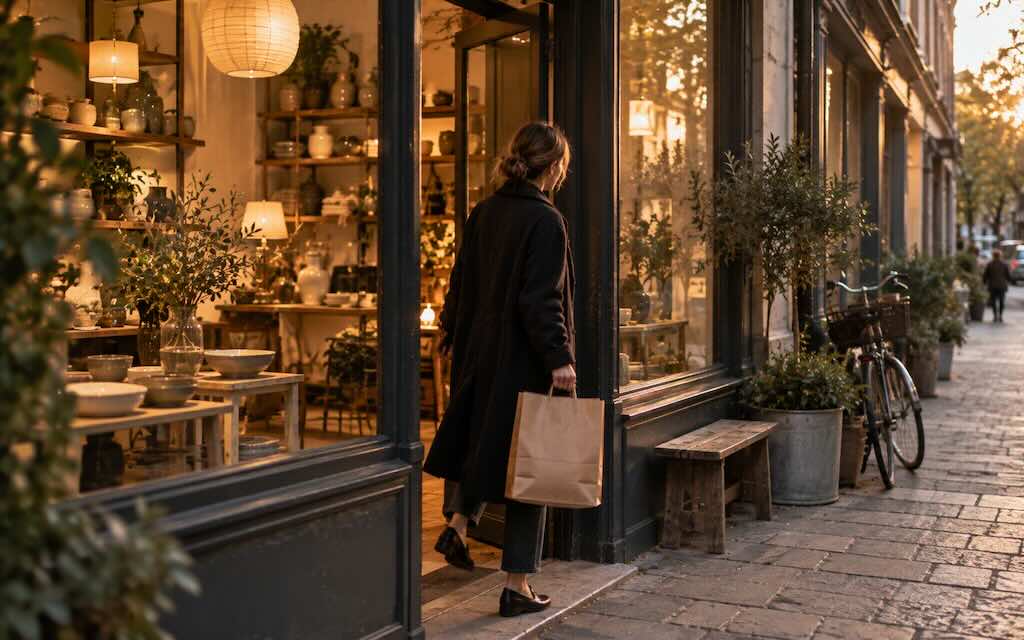
Instead, on Saturday afternoon, you go to look at lamps.
You take the bus into town. Walk past two shops you had forgotten were there. Pick up a ceramic bowl you have no intention of buying. Stand under three different lamps and discover that the one you liked online gives off strangely cold light.
You leave with another one.
Measured purely as a transaction, this is inefficient. Yet physical shopping has survived decades of increasingly convincing alternatives. We can order groceries from the sofa, compare fifty pairs of shoes without taking off our own and buy a birthday present at 11:47 at night.
Still, sometimes we want to go somewhere.
Some things remain difficult to put on a screen
A photograph can show you a blue sweater. It cannot quite tell you what that blue will do in daylight, whether the wool scratches your wrist or whether the weight of it feels reassuring or cumbersome.
This is one of the least mysterious reasons physical shops persist. We use more than our eyes when deciding whether we want something.
In a 2024 survey of more than 23,000 consumers across 30 countries, EY found that 57% wanted to see, touch and feel products before buying them. Academic research has also examined how physical contact can affect purchasing decisions, particularly when qualities such as texture, temperature, weight and hardness matter.
This is obvious with clothes. Less obviously, it applies to an enormous amount of what we buy. The resistance of a drawer. The handle of a mug. The sound of a speaker. The smell of a candle before someone has tried to describe it as rain falling on an Italian garden.
There are properties that become clear only when the object is in the same room as you.
A shop gives you fewer things to choose from
This sounds like a disadvantage until you have opened your fourteenth browser tab.
The internet is exceptionally good at making another option available. There is always another colour, another seller, another model with slightly better reviews, another sale starting tomorrow.
A shop has walls.
There are six kettles on the shelf rather than six hundred. Four are too large, one has a handle you dislike and suddenly the decision is nearly made.
Physical retail places an accidental frame around choice. What is in stock, what fits, what you can afford and what is physically in front of you become the boundaries of the decision. The limitation can be useful.
You stop searching for the theoretically perfect version and decide whether you like this one.
Browsing is different when your feet are involved
Online browsing usually begins with language. You type what you think you want.
A physical shop can begin with something you didn’t know to search for.
You came for socks and notice a book near the till. You turn down an aisle because of a colour. A jacket looks unremarkable on the hanger and unexpectedly right once it is on. The good second-hand shop is built almost entirely around this possibility: you cannot search efficiently for something whose existence you did not know about five minutes ago.
Discovery exists online too, of course. Retail platforms have become exceptionally sophisticated at suggesting what we might want next. But algorithmic discovery is usually informed by something: what we searched, watched, clicked, bought or resembled statistically.
A shelf can be less intelligent and more surprising.
Sometimes the purchase is only half the errand
Going to buy something also gives a day a destination.
You need coffee beans, so you walk twenty minutes. You need a birthday card and end up looking through the bookshop next door. You try on trousers, then have coffee because you are already out.
The thing you needed becomes a reason to move through a place.
This helps explain why the survival of physical retail cannot be understood only through a competition between checkout methods. Recent retail research describes shopping as increasingly mixed between channels rather than cleanly divided between online and offline. Deloitte’s research on Gen Z shopping, for example, found heavy use of digital channels for product research alongside frequent in-person shopping.
We can look something up on the train, inspect it in a shop and order a different colour from bed that evening. The channels have stopped behaving like opposing sides.
What the physical part adds is not merely access to the product. It gives the purchase a place, and sometimes an afternoon around it.
There is someone to ask
A good shop assistant can answer a question you have not phrased correctly enough for a search box.
You explain that you need a pan for a small induction hob, that your feet hurt in one particular place when you run, that the plant will live in a dark corner or that the person receiving the bottle of wine likes something you can remember only as “not too heavy.”
The useful part is not simply expertise. It is interpretation.
The same EY consumer research found demand for personal service remained significant, particularly around higher-value purchases. Search tools can provide extraordinary amounts of information, but information and advice are not quite the same thing.
Occasionally it is easier to describe the problem to a person standing beside the shelf.
You can take the thing home
There is also the uncomplicated pleasure of immediacy.
No tracking number. No photograph of a parcel beside a door that may or may not be yours. No box inside another box, padded with paper, containing the small object you ordered three nights ago and have already half forgotten.
You pay for the loaf and carry it home while it is still warm. The shoes are on your feet that afternoon. The flowers are beside you on the bus.
The transaction ends where it happens.
Not every purchase needs to become an outing
There is plenty we are happy never to shop for in person again.
Ordering the same toothpaste, printer ink or packet of dishwasher tablets is not necessarily impoverishing modern life. Convenience is genuinely convenient. For people with limited mobility, little free time or poor access to shops, online retail can be far more than a pleasant shortcut.
The interesting thing is that convenience did not make the alternative meaningless.
Going somewhere to buy something still lets us inspect, wander, ask, change our minds and encounter things that were not in the search query. It can turn consumption into something slightly larger than the moment money changes hands.
And occasionally you come home without the thing you went out for.
The afternoon was not necessarily wasted.
FAQ
Why do people still prefer shopping in physical stores?
There is no single reason. Physical shops let people see, touch and try products, ask for advice, take purchases home immediately and discover things they may not have searched for online. The importance of each advantage varies by product and shopper.
Why is touching a product important before buying?
Touch provides information that photographs and specifications can struggle to communicate, including texture, weight, temperature, softness and resistance. Research suggests this physical information can affect purchasing decisions in some circumstances, particularly when those qualities matter to the product.
Is in-store shopping disappearing?
Online shopping has changed retail substantially, but physical stores remain an important part of how people buy. Increasingly, the distinction is less absolute: shoppers may research online, inspect something in person and complete the purchase through either channel.
What are the advantages of buying something in person?
Beyond immediate ownership, buying in person can make it easier to judge fit and quality, compare a manageable selection, get human advice and change direction based on what you find. For subjective purchases such as clothing, furniture, fragrance or homeware, those qualities can be particularly useful.