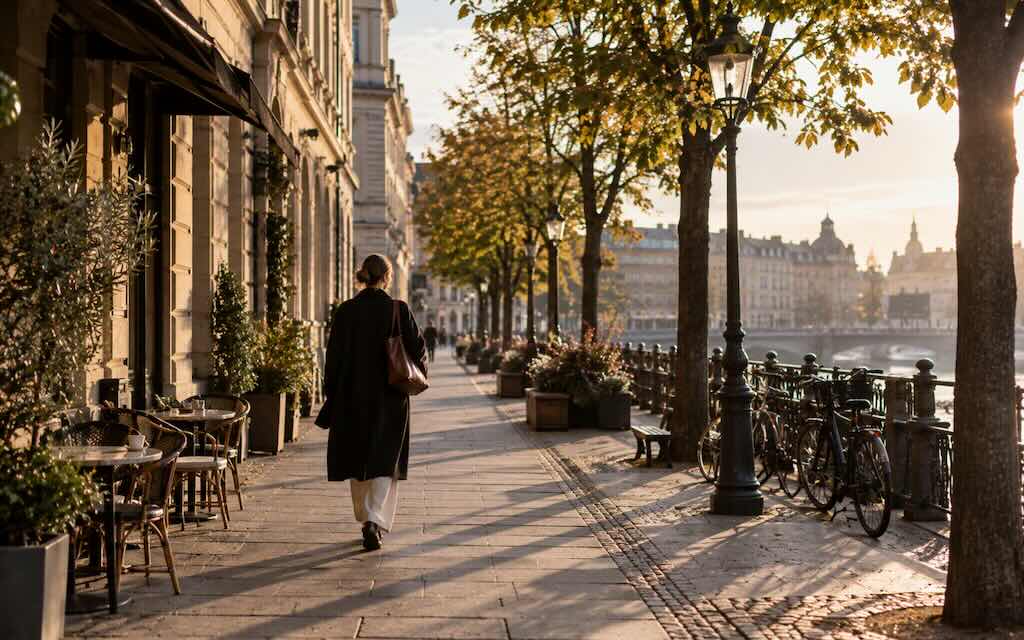
One of the easiest mistakes to make in a new city is trying to see all of it. A map gets opened before the coffee is finished, and by nine the day has already become a checklist: the cathedral, the market, the street everyone photographs, the café saved months ago. Nothing on the list is wrong. But a city seen only through its list can be surprisingly difficult to remember.
What stays can be smaller. A quiet courtyard behind a gate. The particular grey of a canal at eight in the morning. A Lisbon street where one tiled façade gives way to another. The bakery you found because you were walking on the wrong side of the square.
These moments are easy to treat as the space between the important parts of a trip. Walking gives them time to become part of it.
Walk toward something, not through everything
A day does not need twelve destinations to feel full. One anchor for the morning and another for the afternoon — a neighbourhood, gallery, market or lunch reservation — can be enough. The distance between them is no longer dead time that needs to be made efficient.
It also allows a looser relationship with the map. Check where you are going, put the phone away and walk for a while. A church spire, tram line, river or slope can provide enough orientation until you need directions again.
This is not about pretending phones have ruined travel. Getting lost is considerably less charming when you are late, tired or somewhere unfamiliar after dark. Navigation is useful. It simply does not need to occupy the whole walk.
Turn-by-turn directions are very good at telling you where to look next. Sometimes it is worth looking somewhere else.
Keep walking when the postcard ends
The beautiful old quarter eventually becomes something more ordinary. Apartment entrances appear between restaurants. There is a hardware shop, a supermarket, a school gate, bins waiting for collection. The street becomes less obviously worth photographing.
Keep going.
Ordinary streets give the celebrated ones context. They show how people enter and leave their homes, where bicycles accumulate, what is open early, where someone stops for coffee on the way to work rather than because a guide recommended it.
Different cities reveal these transitions differently. Copenhagen’s bridges make moving between neighbourhoods unusually legible. Amsterdam keeps returning the walker to water. Lisbon turns short distances into climbs and descents, so a few streets can change the view completely. Stockholm’s islands make crossing water part of moving through the city rather than something reserved for a sightseeing excursion.
None of these places needs to be approached as a collection of beautiful districts. Some of the pleasure is in finding out what sits between them.
Sit down before you’re tired
Do not wait until your feet hurt to stop.
Sit somewhere that was not designed as a viewpoint: a bench near a playground, the edge of a fountain, a café table facing the street. Stay for ten minutes longer than seems necessary.
A place behaves differently once you are no longer passing through it. Deliveries arrive. Someone drags chairs onto the pavement. A dog chooses a route its owner apparently did not. Regulars greet each other without stopping. A square that looked empty begins to show its routine.
Travel can become strangely compressed when every hour contains something significant. One museum leads to a church, which leads to a celebrated restaurant, which leads to the next thing worth seeing. Sitting down returns some ordinary time to the day.
Walking also happens to be one of the most accessible forms of physical activity. The World Health Organization includes walking in its work on active mobility and physical activity. But a day in a city does not become better because a phone reports 30,000 steps. At some point, distance stops adding experience and starts producing tired feet.
A tram can be part of a walking day
There is an unnecessarily heroic version of city travel in which every kilometre should be covered on foot.
It usually stops being enjoyable somewhere around the moment you realise you are looking mainly at the pavement.
Take the tram. Use the metro to skip a long stretch between neighbourhoods. Ride a bus uphill and walk back down. In a city built around water, a ferry may explain the geography better than another hour following streets around it.
Public transport does something useful for walkers: it changes the scale of the day without requiring you to abandon it. A neighbourhood several kilometres away can become the beginning of a walk rather than an exhausting destination at the end of one.
Not every beautiful city is kind to walkers
“Walkable” can be an imprecise compliment.
A cobbled historic centre may be enjoyable for one visitor and difficult for someone using a wheelchair, pushing a pram or managing limited mobility. Steep gradients, uneven surfaces, missing kerbs, heat, traffic and long staircases rarely feature prominently in photographs of an attractive street.
Good walking depends on more than compactness or architecture. Safe crossings matter. So do accessible pavements, shade, places to rest and useful connections to public transport. The World Health Organization’s work on active mobility similarly considers the infrastructure and conditions that allow walking and cycling to become practical ways of moving around.
For a traveller, the lesson is straightforward: check the route as well as the destination. A tram, lift, funicular or taxi is not evidence that the walking day failed.
Take the long way home
The return journey is one of the easiest opportunities to see something new without adding anything to the itinerary.
Cross at the next bridge. Take the parallel street. Walk one block beyond the obvious turn and come back around. A restaurant street may have quiet apartments behind it. A crowded square may lead into a nearly empty garden. The route that felt commercial at noon can belong to an entirely different crowd by early evening.
Cities change by the hour as much as they change by neighbourhood. Returning somewhere after shops close, offices empty or dinner begins can be more revealing than adding another district simply because it is new.
There is also something pleasant about recognising a corner in a city where, the day before, nothing was familiar.
Leave one walk with nowhere to be
If the trip has room for it, keep an hour empty.
Go out after breakfast without needing to reach anything. Walk toward the water. Follow a street because the light looks better there. Turn because you can hear a market or because the next block seems quieter.
You may find nothing remarkable.
Most cities, after all, contain far more pharmacies, bus stops, apartment buildings and people carrying groceries than monuments. A walk without a destination leaves room for some of that ordinary life to enter the trip.
Later, these can become strangely durable memories: the sound from an open kitchen window, wet pavement after a brief shower, the chairs being stacked outside a café, the sudden coolness of a narrow street after crossing a hot square.
You were not on your way to see them. You happened to be walking when they were there.
FAQ
What makes a city good for walking?
Useful destinations within reasonable distances help, but so do safe crossings, accessible pavements, shade, places to sit and good public transport. Attractive architecture alone does not make a city easy for everyone to explore on foot.
How should you plan a day of walking in a new city?
Choose one or two fixed destinations and leave generous time between them. Check the terrain, weather and transport options beforehand, then allow some of the route to develop as you go.
Should you walk around a city without using maps?
There is no need to avoid maps. Checking directions when necessary can provide orientation and reassurance. Using turn-by-turn navigation less continuously simply gives you more opportunity to look around while you walk.
When should you use public transport instead of walking?
Use it whenever distance, terrain, weather, mobility or fatigue would make the walk less enjoyable or practical. A tram, metro, bus or ferry can also create a better route by allowing you to begin walking in a different part of the city.
Which European cities are rewarding to explore on foot?
Copenhagen, Amsterdam, Paris, Stockholm, Vienna and Florence all have areas where walking connects architecture, public space and everyday neighbourhood life particularly well. Lisbon can also be rewarding on foot, although its hills make route planning and transport alternatives more important.