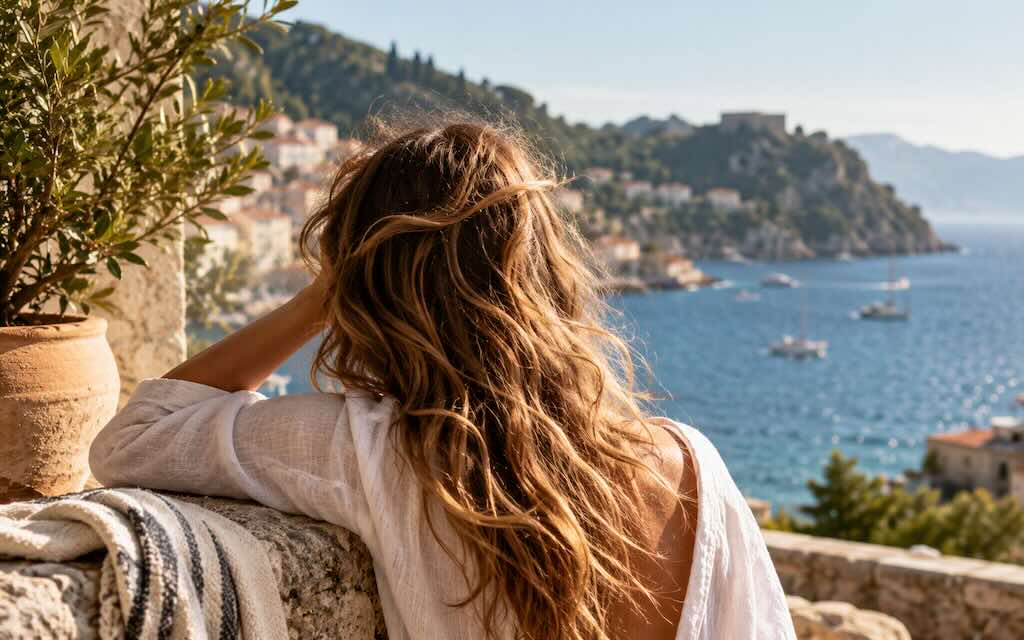
You arrive somewhere new, unpack, take a shower and discover that your hair has apparently travelled somewhere else entirely.
It might suddenly feel softer. Or flatter. Curls that behaved perfectly at home expand in the afternoon air. Hair that usually has movement becomes heavy and uncooperative. Your usual shampoo seems different. The routine you have repeated for years stops producing the same result.
It is easy to blame the miniature hotel hairdryer. Sometimes it deserves it. But travel changes several parts of your hair’s environment at once: the water, humidity, temperature, sunlight, swimming, washing habits and even how often you touch or tie it up.
Your hair has not forgotten how to behave. The conditions have changed.
Humidity can change everything
The most immediately noticeable difference is often the air.
Hair responds to moisture around it. In humid conditions, water molecules interact with the keratin proteins that make up much of the hair fibre, affecting temporary hydrogen bonds within the hair. This is why a carefully straightened style can begin returning towards its natural pattern and why curls can become more pronounced or frizz develops.
The effect is strong enough that, historically, hair itself has been used to measure humidity. As Smithsonian explains in its look at the chemistry of humid hair, strands respond physically to changing moisture in the atmosphere.
This can make arriving somewhere tropical feel almost immediate. You leave an air-conditioned airport, step outside and the atmosphere introduces itself through your hair.
Dry air creates a different experience. Hair may feel less flexible or appear more static, particularly when combined with indoor heating or air conditioning.
The same head of hair can therefore seem to have entirely different characteristics in Stockholm, Singapore and Athens.
Then there is the shower
One of the stranger things about travelling is discovering how geographically specific a shower can feel.
Water varies from place to place. Its mineral composition, treatment and hardness are not necessarily the same as what comes from your tap at home. That can change the experience of washing your hair and how products behave during and after a shower.
You may notice that shampoo seems to lather differently. Hair might feel coated, unusually soft, rough or simply unfamiliar once it dries.
Because your routine remains the same, it is tempting to assume the product has stopped working. Often, the environment around the product is what has changed.
Your bathroom has disappeared too
Travel removes more of our routine than we realise.
At home, hair care happens inside a remarkably controlled little system. The same shower. The same water. The same brush. The same towels. The same products, quantities and drying habits.
Then we travel with a smaller bottle of shampoo, borrow somebody else’s conditioner, use a hotel dryer attached to a wall and attempt to style our hair in a bathroom with unfamiliar lighting.
We may wash it more frequently because we have been swimming or sweating. Or less frequently because mornings are spent getting out of the hotel rather than standing in front of the mirror.
Sometimes what appears to be travel changing our hair is travel changing us.
Sunlight leaves its own trace
A week spent outdoors can expose your hair to considerably more sunlight than an ordinary week at home.
Research on hair fibres has found that ultraviolet radiation can affect hair proteins, pigment and surface structure. Studies indexed by the U.S. National Library of Medicine have observed different forms of hair-shaft damage following UVA and UVB exposure, while a broader review of solar radiation and hair discusses changes including colour, lustre, mechanical properties and surface roughness.
You might notice this most clearly after a long summer. Hair can look a little lighter around the face and ends, particularly where it receives the most sun. Coloured hair may also appear different after sustained exposure.
There is something visually appealing about sun-altered holiday hair: slightly lighter, less controlled, carrying the evidence of being outdoors. But aesthetically pleasing and undamaged are not necessarily the same thing.
The sea gives, then takes
Few hair days feel quite as convincing as the one immediately after swimming in the sea.
Salt water, wind and air-drying can temporarily create the texture that countless styling products try to imitate. Hair separates into imperfect strands. Waves become visible. Everything looks a little less arranged.
Repeated swimming is another matter.
Wet hair is being exposed to water, salt or pool chemicals, followed perhaps by strong sun, wind, brushing and another wash. The cycle can leave hair feeling increasingly rough or tangled, particularly when it is already coloured or chemically treated.
Swimming pools bring their own conditions. The American Academy of Dermatology recommends rinsing hair after swimming and following with shampoo and conditioner to reduce the effects of pool chemicals.
It is a less romantic image than emerging from the Mediterranean and allowing your hair to dry in the sun, but your ends may appreciate it.
Travel changes how we wear our hair
Environment is only half the story.
Think about what happens to your hair during an ordinary travel day.
It gets pressed against an aeroplane seat for several hours. Tied back because it is hot. Released. Tied again. Tucked under a hat. Blown around on a ferry. Slept on while still slightly damp. Brushed quickly before dinner.
None of this is particularly dramatic, but the accumulated friction and manipulation are different from a normal week at home.
There is also the simple fact that we often care less.
On holiday, a slightly unruly texture can feel appropriate. Hair dries while we eat breakfast on a balcony. We go outside before it is finished. The wind does something to it and we leave it alone.
The same hair that might irritate us before a working day can feel completely right beside the sea.
Sometimes holiday hair is better
Not every change is unwelcome.
People occasionally return from a trip wishing they could bring the local water or weather home with them. Curls behaved better. Hair dried with more volume. The air gave it texture without effort.
This reveals something useful about beauty routines: the result is never produced by products alone.
We tend to think of hair as a fixed characteristic and hair care as a sequence of bottles used to manage it. In reality, hair exists in constant conversation with its surroundings. Moisture, water, light, heat and physical handling all participate.
A routine that works beautifully in one environment may need adjustment in another.
You probably don’t need a completely new routine
A short trip rarely calls for rebuilding your bathroom cabinet in miniature.
Instead, pay attention to what has actually changed.
If humidity is bringing out your natural texture, working with it may be easier than repeatedly trying to recreate your hair at home. If swimming is leaving the lengths tangled, rinsing afterwards and using conditioner may matter more than adding several styling products. If you are spending entire days in strong sun, a hat offers the useful combination of shade for the scalp and physical coverage for the hair.
And sometimes the sensible response is to do very little.
Travel already asks us to loosen routines. Hair can be part of that.
There is a particular kind of holiday photograph in which someone’s hair is doing something it would never be permitted to do at home. It is larger, flatter, curlier, saltier or blown entirely across their face.
Years later, that may be part of what makes the photograph good.
The hair belongs to the weather, the water and that particular day.
FAQ
Why does my hair feel different when I travel?
Your hair is exposed to different humidity, water, temperatures, sunlight and daily routines when you travel. Changes in washing, swimming, drying and styling can also affect how it looks and feels.
Why does my hair get frizzy on holiday?
High humidity is a common reason. Moisture in the air interacts with hair fibres and can encourage hair to move towards its natural shape, making waves, curls and frizz more noticeable.
Why does my shampoo feel different in another country?
The water coming from the shower may differ from the water at home, including its mineral content and hardness. That can affect the washing experience and how your hair feels afterwards.
Can the sun change your hair?
Yes. Research has found that UV exposure can affect hair proteins, pigment, colour and surface characteristics. Extended sun exposure can contribute to dryness, roughness and colour changes.
Should I change my hair routine when travelling?
Not necessarily. Small adjustments based on the conditions are usually more practical: consider humidity, how frequently you are swimming or washing your hair, sun exposure and whether your hair feels drier or more tangled than usual.