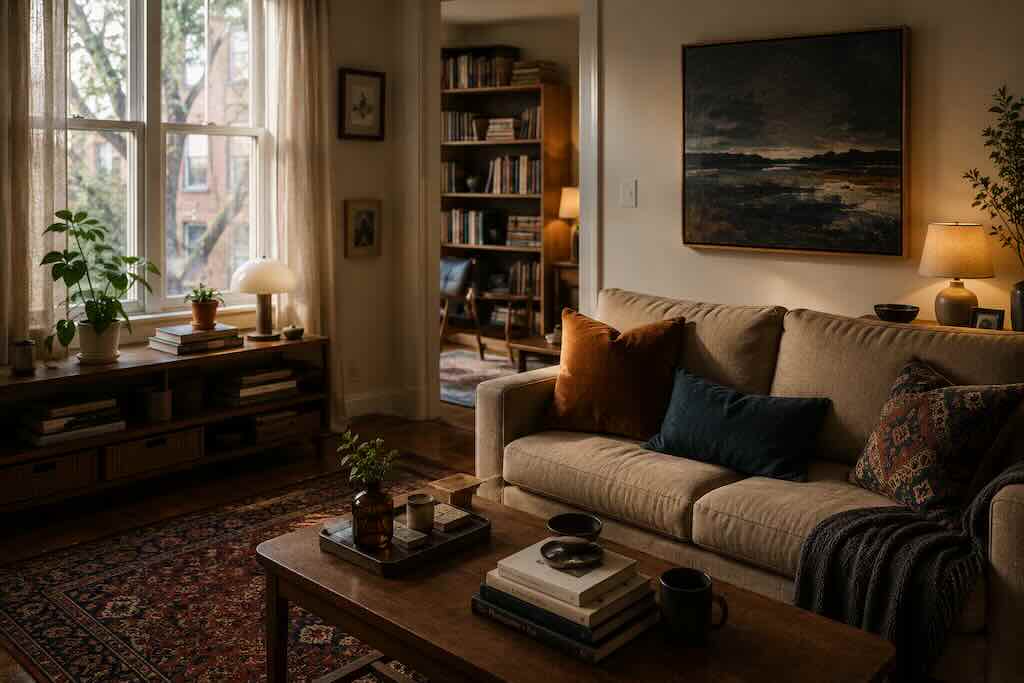
Some rooms seem to lower the volume the moment you enter them.
It may be a living room with books stacked everywhere, an old hotel lounge with dark walls, or a bedroom containing little more than a bed, a chair and a lamp. The styles have almost nothing in common, yet the effect does: you sit down without immediately noticing why you wanted to.
Other rooms do the opposite. Nothing is obviously wrong, but your attention keeps moving. The ceiling light is brighter than it needs to be. There are six small objects on the coffee table, another ten on the shelves and three different patterns competing across the room. A television is running somewhere nearby. Getting to the window means stepping around a chair.
We tend to call the first kind of room calm and then try to reproduce it through a particular look: pale walls, neutral furniture, minimal decoration.
But calm is not an interior design style. A room can be colorful, full of books and deeply personal while still feeling restful. What matters more is how much the room asks you to notice, interpret and negotiate at once.
Table of Contents
- A calm room gives your attention some structure
- Empty space is doing more work than it appears to
- Clutter is more complicated than “less is better”
- Lighting can change the same room completely
- Listen to the room instead of only looking at it
- A room feels better when moving through it is obvious
- Nature works without making a room visually empty
- Color cannot make a room calm by itself
- The calmest homes are rarely the most perfect ones
- Look at the room when you actually need it to feel calm
- Frequently asked questions
A calm room gives your attention some structure
Look around a room you enjoy spending time in and there is often some kind of visual order, even if the room itself is not particularly tidy.
Perhaps a large painting catches your attention first. Maybe it is the window, fireplace, sofa or bookshelf. Smaller things sit around that main element without all trying to become the most interesting object in the room.
This is visual hierarchy, and it matters because our attention is selective. Research on visual perception has shown that objects appearing close together can compete for neural representation in the visual cortex. That laboratory finding does not mean a crowded mantelpiece is inherently stressful, but it illustrates something familiar from everyday experience: processing several competing elements is different from looking at one clearly defined composition.
In a room, the difference can be remarkably ordinary.
Five objects scattered across a console create five separate things to register. The same objects grouped together begin to read as one arrangement, particularly when there is clear space around them.
The objects have not disappeared. The room has simply become easier to read.
Empty space is doing more work than it appears to
One of the easiest mistakes in decorating is assuming that every available space needs something in it.
An empty corner looks unfinished, so a plant goes there. The wall above a cabinet looks bare, so it gets another picture. A clear coffee table receives a stack of books, a candle and a decorative bowl.
Eventually there is nowhere left for the eye to stop.
Empty space is not the absence of design. It changes the way everything beside it is perceived. A painting has more presence when part of the surrounding wall remains clear. A beautiful chair becomes easier to notice when it is not squeezed between a side table, basket and floor plant.
This does not require minimalism. A full bookshelf beside a quiet wall can feel calmer than three sparsely decorated shelves spread across an entire room because the visual activity has somewhere to begin and end.
Clutter is more complicated than “less is better”
The relationship between possessions and wellbeing is often reduced to a simple decorating instruction: remove things and you will feel better.
The research is more interesting than that.
A study of dual-income households found that women who described their homes using more language associated with clutter and unfinished projects showed different daily patterns of mood and cortisol than women whose descriptions emphasized restorative qualities. The study was small and correlational, so it cannot tell us that clutter itself caused those outcomes, but it suggests that how people experience the state of their homes can be connected with stress.
More recent research complicates the assumption that an empty room is necessarily preferable. A 2025 study in the Journal of Environmental Psychology found that private, warm, biophilic and even somewhat cluttered interiors could support psychological needs better than cold, empty alternatives in the environments researchers tested.
That distinction feels important in a real home.
Books, records, children’s drawings, photographs, ceramics and objects brought home from trips can make a room richer and more personal. The question is less whether a room contains things than whether those things feel intentionally placed or permanently unresolved.
Lighting can change the same room completely
A living room at two in the afternoon and the same room at nine at night are almost different interiors.
During the day, daylight does much of the work. It moves across walls, changes the appearance of materials and creates natural variation between brighter and darker parts of the room.
At night, many homes replace all of that with one ceiling fixture.
The result can feel strangely exposed. Everything is illuminated at approximately the same level, including areas where nobody is doing anything.
A calmer evening room often contains several smaller sources instead: a lamp beside the sofa, another near a chair, perhaps a pendant over the dining table. Light gathers around the places being used while other parts of the room are allowed to recede.
There is a physiological reason for thinking about light across the day as well as an aesthetic one. Light is one of the major environmental signals affecting human circadian rhythms, which is why indoor-light recommendations generally favor stronger daytime exposure and lower light levels toward evening.
But you do not need to make a room permanently dim. Calm and darkness are not synonyms. The useful question is simpler: does the light suit what is happening in the room right now?
Listen to the room instead of only looking at it
Interior photographs are silent, which makes it easy to forget that real rooms are not.
A beautiful space with hard floors, bare glass and large undecorated walls can have a surprising amount of echo. Footsteps become sharper. Plates and glasses sound louder. A conversation from the other side of the room seems to occupy all of it.
Soft materials alter those reflections. Rugs, upholstered furniture and curtains do acoustic work at the same time that they add texture and warmth.
Then there are sounds that have nothing to do with decoration: a refrigerator hum, road traffic, an extractor fan, a rattling vent or a television that remains on when nobody is really watching it.
The World Health Organization identifies environmental noise as an important health issue, particularly in relation to effects including annoyance and sleep disturbance. An ordinary home is obviously different from population-level environmental-noise research, but the broader point is useful: sound changes how environments are experienced.
Sometimes the least relaxing thing in a room cannot be seen in a photograph.
A room feels better when moving through it is obvious
There is another form of calm that has very little to do with decoration.
You should be able to understand how to use a room without repeatedly negotiating with the furniture.
A chair with a lamp and table beside it has an obvious purpose. Sofas positioned toward one another make conversation easy. A dining chair needs enough room behind it to be pulled out. The route between the door and the sofa should not require a sideways step around the coffee table.
These sound like tiny inconveniences, and individually they are. But homes are experienced through repetition. If you move around the same chair five times every day, that awkward placement becomes part of the room whether or not you consciously notice it anymore.
Before buying storage or replacing furniture, watch how you actually move through the space. Where do you hesitate? Where do you put something down because its proper home is inconvenient? Which chair is always pushed out of the way?
Sometimes moving one piece of furniture six inches solves more than buying another piece.
Nature works without making a room visually empty
A view of trees is visually complicated. So is a large plant. Leaves overlap, branches move, shadows change and nothing is particularly symmetrical.
Yet natural complexity often feels different from a shelf containing twenty unrelated decorative objects.
The relationship between natural environments and restoration has been studied for decades, and contemporary environmental-psychology research continues to investigate how biophilic elements affect our experience of interiors. This does not mean every calm room requires houseplants, nor that adding a fiddle-leaf fig is a psychological intervention.
There is a simpler design lesson available.
Nature introduces detail without requiring everything to remain visually fixed. A tree outside the window changes with the weather. A plant throws different shadows throughout the day. Wood and stone contain irregularities that prevent a room from feeling completely manufactured.
Calm does not have to mean visually lifeless.
Color cannot make a room calm by itself
Search for calming interiors and a familiar palette appears: warm white, beige, pale gray, dusty green and muted blue.
Those colors can create beautiful rooms. They are not a prescription.
A dark green library can feel quieter than a white kitchen. A room painted deep red can be enveloping rather than stimulating. A pale neutral space can feel peaceful or strangely sterile depending on the light, materials, proportions and person living there.
Instead of searching for the calmest paint color, it can be more useful to think about how many strong contrasts the room contains.
If the walls, curtains, rug, sofa, cushions and artwork all introduce unrelated colors and patterns, the room contains a great deal of visual information. Repeating several tones across different elements can create coherence without removing color.
Texture can then provide the variation: timber grain, wool, linen, plaster, stone, aged leather, brushed metal.
A room can be interesting close up and quiet from the doorway.
The calmest homes are rarely the most perfect ones
There is a point at which designing entirely for serenity produces something that feels less like a home and more like a rendering.
No cables. No magazines. No shoes beside the door. Nothing on the kitchen counter. One enormous ceramic vase occupying a table nobody apparently uses.
Real homes generate visual evidence of living in them.
The goal does not have to be eliminating that evidence. It can be giving it some boundaries.
Let the books fill the bookshelf. Keep photographs together. Give chargers and remote controls somewhere obvious to return to. Allow the kitchen to look like people cook in it, while protecting one section of counter from becoming permanent storage.
Then leave something alone.
An empty section of wall. A clear end of the dining table. A corner where the only thing happening is the afternoon light.
Look at the room when you actually need it to feel calm
If a room never feels quite right, evaluating it on a bright weekend afternoon may not tell you very much.
Look again at the end of an ordinary day.
Notice the first thing that bothers you when you walk in. Perhaps the overhead light is too harsh. The coffee table has become a holding area for everything carried through the door. The chair you prefer is positioned where nobody naturally wants to sit. The room echoes. Every surface is occupied, yet there is nowhere convenient to put down a cup.
Change that thing first.
Not the wall color. Not the sofa. Not the entire aesthetic identity of the room.
Move the lamp. Clear part of the table. Shift the chair. Group the objects. Turn off the sound nobody is listening to.
Then spend a few evenings there before deciding what else needs fixing.
A calm room is not one that has been stripped of personality. It is one where the things competing for your attention have reached some kind of agreement.
Frequently asked questions
What makes a room feel calm?
There is no single formula, but visual hierarchy, manageable amounts of competing information, comfortable lighting, clear circulation, appropriate sound levels and some quieter areas within the room can all contribute. Personal preference matters as much as decorating style.
Does clutter make a room feel stressful?
Clutter can increase visual complexity, and research has found associations between how people perceive their home environment and measures of wellbeing or stress. That does not mean every possession is harmful or that minimalist rooms are inherently healthier. Grouping objects and dealing with areas that feel permanently unfinished may be more useful than trying to remove everything.
What colors make a room feel more relaxing?
No paint color is universally calming. Rather than choosing a color solely because it is marketed as relaxing, consider the room’s natural light, materials, contrast and your own response to the color. Repeating a smaller number of tones can create visual coherence without limiting the room to neutrals.
Can a colorful or maximalist room still feel calm?
Yes. A room can contain strong color, books, art and collections while still having clear visual hierarchy and areas of relative quiet. Grouping collections, repeating colors and leaving some negative space can make a richly decorated room easier to read.
How can I make a room feel calmer without redecorating?
Start with the sources of friction you already notice. Clear part of one busy surface, group scattered objects, adjust harsh evening lighting, reposition furniture that obstructs movement and listen for unnecessary background noise. Small changes can reveal whether larger decorating changes are actually necessary.