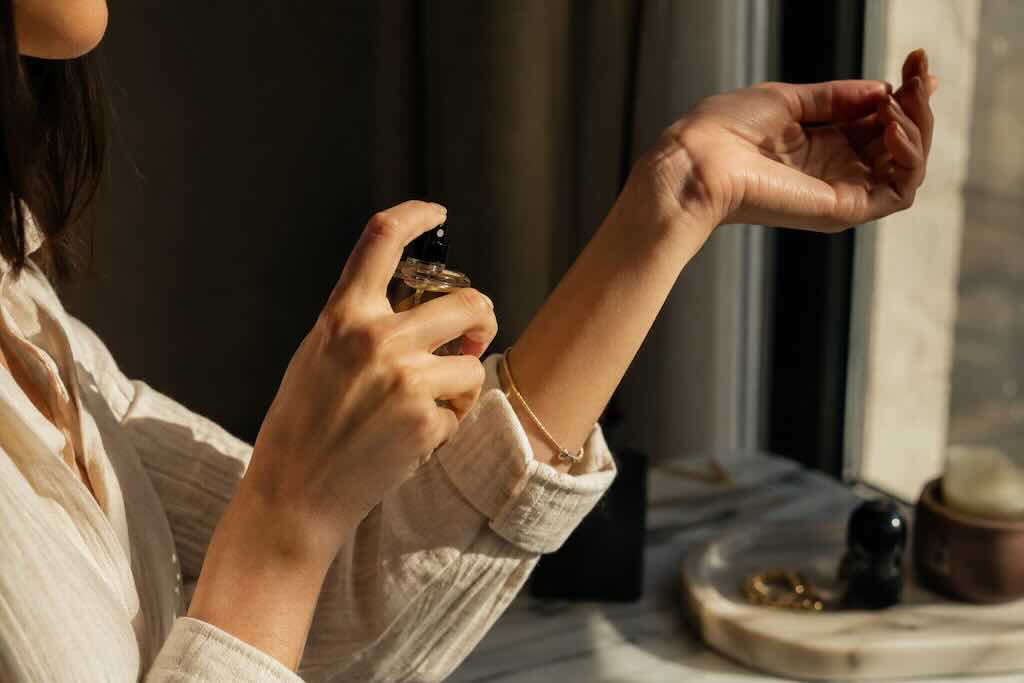
A perfume can feel almost startlingly different eight hours after you spray it. The brightness that was obvious in the morning may have disappeared. Something softer, warmer or more woody sits closer to the skin. Sometimes the fragrance seems richer. Sometimes it is barely there.
That change is not simply your imagination, and it is not quite as simple as the familiar idea that every perfume moves neatly from “top notes” to “heart notes” to “base notes.” What you smell at the end of the day is the result of evaporation, the composition of the fragrance, its interaction with skin and the way your own perception changes during hours of exposure.
Table of Contents
- A perfume starts changing as soon as you spray it
- Top, middle and base notes are useful — but they are not a stopwatch
- Your skin is part of the environment
- The day around you matters too
- Your nose changes its attention
- Air can change fragrance materials as well
- How to find out what a perfume really smells like on you
- Frequently asked questions
A perfume starts changing as soon as you spray it
Perfume is a mixture of aromatic materials carried in a base that commonly includes alcohol. Once it reaches warm skin, the more volatile components begin moving into the air, where they can reach your nose.
They do not all disappear at the same rate. Different fragrance materials have different physical properties, so the balance of what remains on the skin shifts over time. Research into fragrance chemicals and skin exposure has specifically had to account for both skin uptake and loss through evaporation.
This is one reason the opening of a perfume can feel expansive while its late stages become quieter and closer. The fragrance itself has not suddenly turned into an entirely different product. You are smelling a changing proportion of its components.
Top, middle and base notes are useful — but they are not a stopwatch
Fragrance is often described as a pyramid: lighter top notes appear first, heart notes emerge next and longer-lasting base notes remain at the end. It is an intuitive way to describe how a composition develops, but real perfume does not necessarily unfold in three clean stages.
Materials overlap. Some remain perceptible for much longer than their position in a traditional fragrance pyramid might suggest. Others fade quickly. Modern fragrance materials can also be used to create effects that remain recognizable across much of the wearing time.
Think less about three doors opening one after another and more about a room in which the light is gradually changing. The furniture is still there, but different things become noticeable.
Your skin is part of the environment
There is a persistent piece of fragrance folklore that perfume simply reacts with each person’s unique “body chemistry,” explaining every difference between one wearer and another. The reality is more interesting — and less tidy.
Laboratory research examining how perfume behaves after being deposited on skin has found that physical interactions between perfume and skin matter. Researchers comparing fragrance on skin with fragrance on an inert surface found differences in its behavior. On clean, dry skin, however, evidence for extensive chemical transformation of perfume ingredients was relatively limited under the conditions studied.
So when the same perfume seems different on skin than it does on a paper blotter, it does not require a mysterious chemical reaction to explain it. Skin is simply a very different surface from paper: warm, complex and capable of affecting how fragrance materials are retained and released.
The day around you matters too
A fragrance is worn in an environment, not a laboratory vial. During a normal day, skin temperature changes. Clothes cover and uncover different areas. You move between heated or air-conditioned rooms and outdoor air. A fragrance applied beneath a sleeve experiences different conditions from one sprayed onto an exposed wrist.
Where you apply perfume can therefore affect the experience of wearing it. So can the formulation itself. A volatile material disappearing from the surface, for example, is a different process from a material being retained by or absorbed into the skin.
This also helps explain why judging a fragrance from its first few minutes can be misleading. The opening tells you something important about a perfume, but not necessarily what will accompany you through dinner, a train ride home or the last hour before bed.
Your nose changes its attention
There is another variable that is easy to overlook: the perfume is changing, but so is your awareness of it.
Our sensory systems respond differently to persistent stimulation than they do to something newly encountered. A fragrance that was immediately noticeable when you put it on may become much less prominent to you after prolonged exposure.
That is why repeatedly checking your wrist is not always a reliable test of whether a perfume has disappeared. Someone entering your space may notice a scent that has largely receded from your own attention.
Air can change fragrance materials as well
There is a separate chemical process worth distinguishing from ordinary evaporation. Certain fragrance ingredients can oxidize when exposed to air. Linalool, for example, is widely used in fragranced products, and researchers have documented how it forms oxidation products after air exposure. A 2024 review of fragrance contact allergy likewise identifies linalool and limonene as fragrance materials whose oxidized forms can become contact allergens.
This matters particularly for fragrance sensitivity and storage, but it should not be confused with the normal development of every perfume across a single day. A scent becoming warmer or less citrusy by evening is usually better understood through the changing balance of volatile materials and the conditions in which the fragrance is being worn, rather than assuming it has chemically transformed on your skin.
How to find out what a perfume really smells like on you
If you are deciding whether to buy a fragrance, give it time.
Smell it on paper first if you want to understand the composition without immediately committing it to your skin. Then, if appropriate for you, test it on clean skin and resist making a decision from the opening alone. Notice it again after an hour, several hours later and near the end of the day.
Pay attention to what remains rather than only asking whether the fragrance is still “strong.” Does something dry and woody appear? Does the sweetness become more apparent after the brighter elements recede? Does it stay close to the skin, or can you still detect it without deliberately searching for it?
That later version deserves as much attention as the first spray. The opening may be what catches you at a fragrance counter. The quieter scent left on your skin hours later is the one you may actually spend more of your life wearing.
Frequently asked questions
Why does perfume smell different after a few hours?
Fragrance materials evaporate and are retained at different rates, changing the balance of the composition you can smell. Skin and environmental conditions can also affect how fragrance behaves, while prolonged exposure can make you less aware of a scent that is still present.
Why does the same perfume smell different on different people?
Perfume is being worn on a complex biological surface rather than an inert fragrance strip. Physical interactions with skin and differences in the wearing environment can affect fragrance behavior. It is better not to attribute every variation to a vague idea of “body chemistry,” however; the science of perfume on skin is more complicated than that shorthand suggests.
Should I test perfume on skin before buying it?
If you can safely wear fragranced products, testing on skin can tell you more about how the perfume behaves during actual wear. Give it several hours rather than deciding entirely from the first spray. Anyone who develops irritation or suspects a fragrance allergy should stop using the product and seek appropriate medical advice.
Why can other people smell my perfume when I cannot?
Continuous exposure can reduce how noticeable a persistent smell feels to you. Someone encountering the fragrance without that prolonged exposure may perceive it more readily.