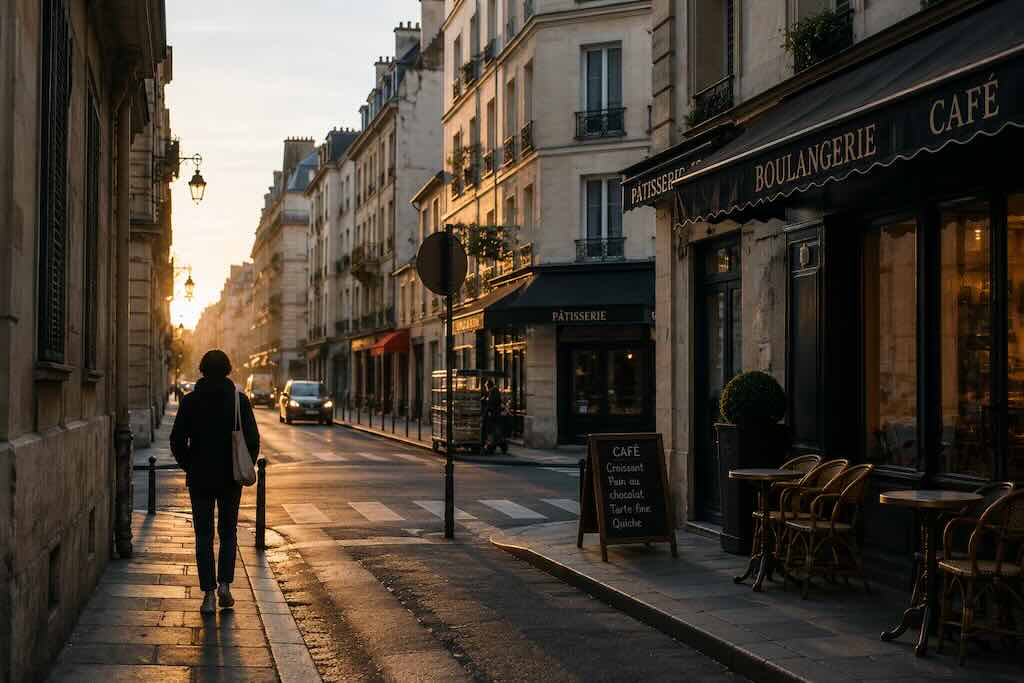
There is a version of almost every destination that disappears by breakfast.
You find it when you leave the hotel earlier than planned, perhaps because you woke up in a different time zone or could not fall back asleep. The lobby is nearly empty. Outside, chairs are still stacked at cafés. Delivery vans occupy spaces that will later belong to taxis. Someone is washing a sidewalk. A bakery has its lights on but has not yet put anything outside.
The street you walked down the previous afternoon is recognizably the same street, but it does not feel like the same place.
There is less traffic, less conversation and less competition for your attention. Buildings become easier to notice. Sounds travel farther. You can hear someone unlocking a shop from half a block away.
For a short time, you are somewhere that has not quite started performing its daytime role.
Table of Contents
- A city changes more than we realize over the course of a day
- There is less asking for your attention
- Quiet changes the scale of a place
- You see the work that creates the version visitors know
- Morning light gives familiar streets another architecture
- There is freedom in not having anywhere open yet
- You can become briefly aware of the people who actually live there
- The streets feel temporarily available
- This is not an argument for becoming a 5 a.m. traveler
- You may remember the hour when almost nothing happened
- Frequently asked questions
A city changes more than we realize over the course of a day
We tend to remember places as though they have fixed personalities.
Rome is busy. Tokyo is energetic. Paris is romantic. New York is loud.
But a city is not one continuous atmosphere. It is a sequence of different conditions occupying the same geography.
The corner filled with restaurant tables at 8 p.m. may belong to delivery workers at 6 a.m. A shopping street that feels almost theatrical on Saturday afternoon can be strangely spacious on Sunday morning. The square where hundreds of people photograph the same building later in the day may briefly contain little more than pigeons and someone crossing it on the way to work.
Travel often gives us only the busiest version because our schedules overlap with everyone else’s. We eat when restaurants are open, visit attractions during opening hours and walk through neighborhoods when shops and cafés are active.
Go out earlier and you encounter the transition instead.
There is less asking for your attention
Popular destinations can be visually demanding.
There are signs, menus, storefronts, traffic, other visitors, street performers, advertisements, bicycles, buses and phones being held in the air. None of these things is necessarily unpleasant. Together, however, they create a large amount of information to process.
Early in the morning, some of those layers temporarily disappear.
A façade that seemed like background yesterday becomes obvious. You notice the color of shutters above a restaurant. The width of a street. A fountain you somehow walked past twice. The sound your shoes make on the pavement.
Novel environments already have a strong claim on our attention. Research into novelty and memory suggests that novel experiences can play an important role in what travelers notice and later remember. When some of the usual daytime competition for attention falls away, there can simply be more room to observe the place itself.
Quiet changes the scale of a place
Sound is one of the least photographed parts of travel and one of the things that most strongly changes how a street feels.
Traffic is particularly important. The World Health Organization identifies road traffic as a major source of urban environmental noise, with noise levels generally rising alongside traffic volume and speed.
That means a street before the main traffic of the day can be more than simply less crowded. Its entire acoustic character can change.
In the absence of a constant layer of engines, horns and movement, smaller sounds move forward.
A rolling metal shutter. Cups being arranged behind a counter. A bus braking somewhere out of sight. Birds occupying trees you did not notice contained birds. Two people talking across an otherwise empty street.
Large places can suddenly feel intimate.
You see the work that creates the version visitors know
One of the pleasures of being somewhere early is seeing a destination before it appears ready.
Someone is putting cushions onto chairs. Flowers arrive outside a shop. Bread is carried through a doorway. Market stalls are assembled. Hotel staff change shifts. Restaurant deliveries appear through entrances you would barely notice at dinner.
These are ordinary working routines, not attractions.
That is precisely why they can be interesting.
Travel can make places seem as though they exist primarily for the people visiting them. The early morning quietly corrects that impression.
The beautiful café is also somebody’s workplace. The market requires trucks and boxes before it requires customers. The spotless hotel lobby has people maintaining it before most guests come downstairs.
You are seeing a little of the machinery behind the finished scene.
Morning light gives familiar streets another architecture
Then there is the light.
Low morning sunlight reaches streets from angles that midday light cannot. One side of a building may glow while the opposite side remains cool and shaded. Long shadows make pavement, steps, balconies and window frames unusually distinct.
A street can look wider. Stone can appear warmer. Glass catches light differently. Details emerge and disappear as the sun moves between buildings.
This is not only why photographers like early mornings. It changes how a traveler reads the place.
Architecture that seemed decorative in the middle of a crowded afternoon can suddenly become the main event.
There is freedom in not having anywhere open yet
Most travel days come with decisions.
Where should we eat? What should we see? How long will the line be? Do we have time for the museum before lunch? Should we book something for tonight?
Early morning can temporarily remove many of those questions because there is not much you can do about them yet.
The museum is closed. Lunch is hours away. Shops have not opened. Nobody expects you to have accomplished anything by 7:15.
So you walk.
Perhaps you find coffee. Perhaps you turn down a street because the light looks good at the other end. Perhaps you sit somewhere for ten minutes without wondering whether it is one of the places you were supposed to visit.
It is travel with unusually little pressure to make travel happen.
You can become briefly aware of the people who actually live there
There is a particular kind of person you notice in a city early in the morning: someone who clearly has somewhere ordinary to be.
A commuter waits for a bus. A parent walks with a child. Someone buys breakfast without examining the menu because they have ordered it dozens of times. A dog follows a route it appears to know better than you know the entire city.
None of this gives a visitor privileged access to the “real” destination. That idea can become romantic very quickly. Residents rushing to work are not performing authenticity for travelers either.
But it does restore an important sense of proportion.
You are visiting a place where other people’s ordinary Tuesdays happen.
That can make somewhere more interesting, not less.
The streets feel temporarily available
There is something psychologically different about walking through a place without constantly adjusting your path around other people.
You can slow down without blocking anyone. Stop beneath a building and look upward. Cross a square diagonally simply because you can. Change direction without being carried by the movement of a crowd.
Active exploration itself may matter to how unfamiliar places are experienced and remembered. Experimental research has found that actively exploring a novel environment can influence subsequent memory, although researchers caution that the relationship between novelty, exploration and memory is complex.
You do not need neuroscience to make an early walk worthwhile. But it captures something recognizable about travel: discovering a place by choosing your own turns feels different from moving through a route already chosen for you.
This is not an argument for becoming a 5 a.m. traveler
There is no need to turn this into another rule for traveling correctly.
If getting up before sunrise makes you miserable, the resulting experience is unlikely to be improved by knowing the sidewalks are quieter.
Nor is morning automatically the best time to experience somewhere. Some places make more sense late at night. Others become interesting precisely when everyone arrives. A crowded square, packed beach or noisy market can be part of what gives a destination its character.
The point is not that empty is better than busy.
It is that they are different versions of the same place.
If you happen to wake early — from jet lag, sunlight through unfamiliar curtains or simply because travel has disrupted your normal rhythm — there is no requirement to turn over and wait for the official day to begin.
You may remember the hour when almost nothing happened
Trips tend to be organized around things that sound worth remembering.
The museum. The famous restaurant. The view. The concert. The building you crossed a city to see.
Yet travel memories are not always so cooperative.
Years later, what returns may be an almost empty street at seven in the morning.
The smell of bread from somewhere you never identified. A person sweeping outside a shop. Cold air before the day became warm. The first cup of coffee. The strange pleasure of realizing that for the next hour, you had nowhere in particular to be.
Then the shutters rise, traffic arrives, tables fill and the place becomes the version everyone came to see.
You just happened to meet it a little earlier.
Frequently asked questions
Why do cities feel different early in the morning?
Traffic, pedestrian activity, businesses, light and ambient noise all change over the course of a day. Early morning often removes some of the visual and acoustic activity associated with peak daytime hours, making architecture, smaller sounds and everyday routines easier to notice.
Is early morning a good time to explore a city?
It can be, particularly if you enjoy quieter streets, walking and observing a destination before many shops and attractions open. It is not necessarily the best time for every place, however, and travelers should consider local safety, transportation and neighborhood conditions before heading out very early.
What can you do in a city before attractions open?
Walking through an appropriate neighborhood, finding a café or bakery, visiting a waterfront or public space, watching a market set up or simply exploring streets near your accommodation can make an early morning worthwhile without requiring a formal itinerary.
Why are places sometimes more memorable when they are quiet?
There is no rule that quiet places are inherently more memorable. However, fewer competing sights and sounds may allow particular details to receive more attention. Research also suggests that novelty and active exploration can contribute to memory, although the relationship varies according to the person and situation.
Do you need to wake up at sunrise when traveling?
No. Early mornings are simply one way of experiencing a destination under different conditions. A good trip does not require sacrificing sleep or following a rigid morning routine, and some destinations are at their most distinctive later in the day or at night.