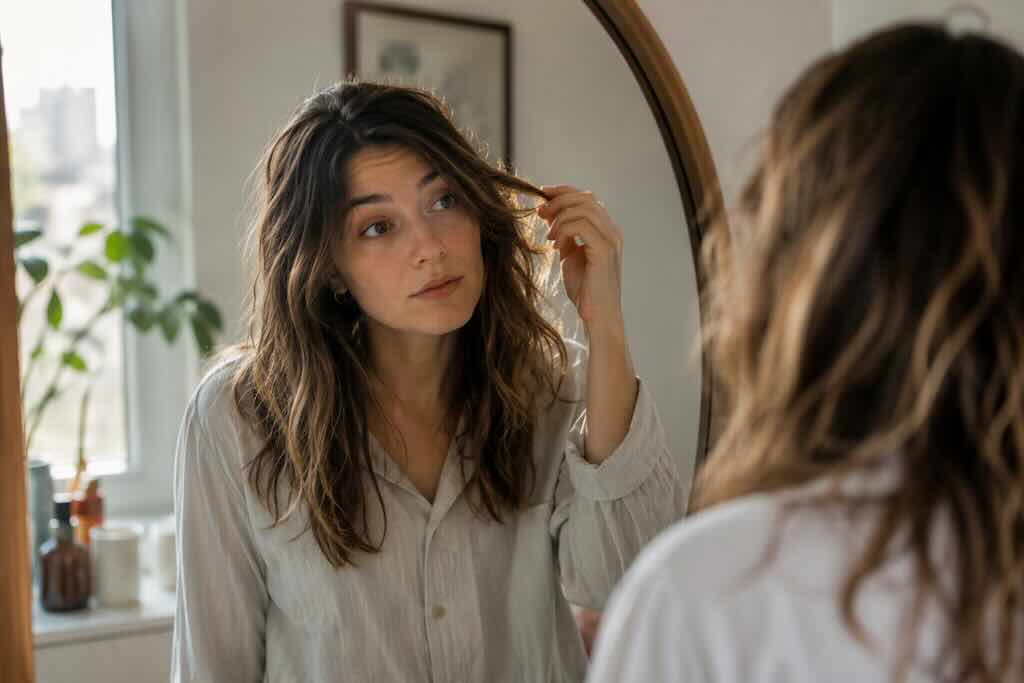
You can wash your hair the same way, use the same products and spend roughly the same amount of time styling it — and still wake up the next morning with hair that seems to have made its own decisions.
One day it falls exactly where you want it. The next, the front pieces bend differently, the roots sit flatter, one side has more volume and a section at the back refuses to behave as it did yesterday.
It is tempting to blame technique. Maybe you used too much conditioner. Maybe you dried it differently. Maybe yesterday was simply a good hair day.
But hair is unusually responsive to its surroundings. Water, humidity, friction, oil, heat and the condition of the hair fiber itself can all change how it behaves. What looks like randomness is often the result of many small variables arriving at once.
Table of Contents
- Hair is more responsive to water than it looks
- Humidity can quietly redraw your hairstyle
- Yesterday’s hair is still in today’s hair
- Then you spend eight hours sleeping on it
- Not every strand of hair is in the same condition
- The way hair dries matters
- Your hands are styling your hair all day
- Sometimes hair looks better after you stop trying to fix it
- A good hair day is difficult to reproduce because it was never one thing
- Frequently asked questions
Hair is more responsive to water than it looks
A strand of hair may look solid and fixed, but its shape is not completely permanent.
Hair is largely made of keratin proteins, and some of the interactions that help determine its temporary shape are affected by water. Research into the physical behavior of hair has shown that water content and humidity can influence the bonds involved in temporary hair shape.
This is part of the reason wet hair can be styled into a different shape and hold some of that shape after drying. It also helps explain why the result is not necessarily permanent.
The atmosphere can start negotiating with your hairstyle as soon as you leave the bathroom.
Humidity can quietly redraw your hairstyle
Humidity is the obvious suspect on a day when carefully smoothed hair begins to expand, curl or frizz outside.
But the effect does not always have to be dramatic.
A modest difference in moisture can be enough to alter how individual strands sit together. Hair that looked smooth yesterday may have slightly more volume today. A wave can become more pronounced. A fringe may bend in a direction you did not intend.
The result depends partly on the hair itself. Straight, wavy, curly, coily, untreated, bleached and chemically processed hair do not all respond identically, and differences in porosity and surface condition can affect how readily hair interacts with water.
So two mornings with apparently identical routines may not really begin under identical conditions at all.
Yesterday’s hair is still in today’s hair
Hair also carries evidence of what happened to it previously.
Conditioner, styling cream, dry shampoo, hairspray, oil and other products can remain on the hair to varying degrees. Natural oils from the scalp also move onto the hair over time.
That changes the way strands interact.
Freshly washed hair can sometimes feel unusually light, soft or difficult to control. A day later, a small amount of natural oil and remaining product may give it enough weight and texture to sit differently.
This is one reason “second-day hair” can feel easier to style for some people. It is not necessarily healthier or objectively better. Its surface conditions have simply changed.
Then you spend eight hours sleeping on it
There is another part of the hair routine we rarely think of as styling: sleep.
For hours, your hair is pressed between your head, pillow, bedding and sometimes your shoulders. You turn over. Hair gets trapped beneath your neck. One side may remain compressed longer than the other.
That means the shape you wake up with is partly a record of what happened overnight.
Friction matters to hair more generally. Reviews of hair-fiber science describe combing, brushing, heat, cosmetic treatments and environmental exposure as contributors to hair weathering, the gradual deterioration of the hair shaft.
One night against a pillow is not equivalent to years of damage, of course. But mechanically, hair is being moved, bent and rubbed while you sleep. The arrangement you carefully created in front of the mirror does not remain untouched until morning.
Not every strand of hair is in the same condition
We often talk about “the hair” as though every inch of it were the same material.
It isn’t.
The hair near your scalp is relatively new. The ends of long hair may have been exposed for years to washing, sunlight, brushing, heat, coloring, clothing and weather.
That history matters. Scientific reviews of hair weathering note that older sections toward the ends generally show more accumulated damage than newer hair close to the scalp.
The result is a head of hair made up of fibers with different histories, plus sections of each individual strand that have experienced different amounts of wear.
Your roots can therefore respond differently from your ends even when the same product touches both.
The way hair dries matters
Small differences during drying can become surprisingly visible later.
Perhaps you parted your hair slightly farther to one side. Perhaps one section remained damp longer because it was underneath another. Maybe you tucked your hair behind your ear while getting dressed or leaned against the back of a chair before it had completely dried.
Those moments can influence the temporary shape that settles in.
Heat adds another variable. Hair-fiber research has found that repeated high-temperature drying can affect the hair surface, with greater damage occurring as temperature increases.
But even without damaging levels of heat, the combination of moisture, temperature, tension and direction used during styling helps determine the result.
You may think you repeated yesterday’s blow-dry exactly. Your hair only needs a few small differences to disagree.
Your hands are styling your hair all day
Hair does not stop changing once you leave the mirror.
You tuck it behind your ears. Push it away from your face. Put on sunglasses. Take off a sweater. Lean against a headrest. Walk through wind. Tie it up for an hour and release it again.
None of these things feels like hairstyling.
Together, they are.
By late afternoon, your hair has been exposed to a sequence of tiny mechanical events that yesterday’s hair may not have experienced in quite the same order.
Sometimes hair looks better after you stop trying to fix it
There is a familiar annoyance in spending 20 minutes trying to make hair sit correctly, giving up, leaving the house and discovering several hours later that it now looks better.
Part of this can be physical. Hair settles. Product distributes. Moisture changes. Individual strands move into less rigid arrangements.
But something else may be happening too: you have stopped inspecting it from six inches away.
Bathroom mirrors encourage an unusual degree of scrutiny. A small irregularity at the front of your hair can seem enormous when it is the thing you have been staring at for five minutes.
Later, you encounter your hair as everyone else does: as part of your whole appearance, moving while you move.
The strand that seemed catastrophically misplaced in the morning may turn out to have been simply a strand of hair.
A good hair day is difficult to reproduce because it was never one thing
This may be the frustrating answer to why yesterday’s hair was so good.
There probably was not one reason.
The humidity suited it. You used the right amount of product without measuring it. It dried in a favorable position. You slept differently the night before. The roots had enough lift and the ends enough weight. You touched it less. Or you simply liked the way it looked and therefore stopped trying to improve it.
Hair is not an object we arrange once each morning. It is a flexible material moving through an environment.
That makes perfect repeatability unlikely.
It also makes the unexpectedly good days possible.
Frequently asked questions
Why does my hair look different every day?
Hair responds to changing conditions including humidity, water, natural oils, styling products, friction, heat and the way it dries. Sleeping, touching your hair and ordinary activities throughout the day can also change its shape, so repeating the same routine does not guarantee an identical result.
Why does humidity make hair frizzy?
Hair interacts with moisture in the air. Changes in water content can affect temporary bonds within the hair fiber and alter its shape. The visible effect varies according to hair type, condition, styling and previous chemical treatment.
Why does my hair sometimes look better the day after washing?
For some people, freshly washed hair can be very light or slippery. By the following day, natural scalp oils, remaining styling products and normal handling may change the weight and texture of the hair, making it easier to arrange. This varies considerably between hair and scalp types.
Can sleeping change the way my hair looks?
Yes. Hair is compressed, bent and moved against bedding for several hours while you sleep. The resulting friction and pressure can flatten roots, alter waves or curls and create bends in particular sections by morning.
Why do the ends of my hair behave differently from the roots?
The hair near the scalp is newer, while the ends of longer hair have usually experienced more washing, brushing, sunlight, heat and other environmental or cosmetic exposure. This accumulated weathering can change the surface and physical behavior of older parts of the hair fiber.